The published sizing rules do not agree on what to measure. ASICS works from the foot in centimetres, Running Warehouse from the space left in front of the toes, and RunRepeat from the inside length of the shoe, so how to choose running shoes size depends on picking one of the three and keeping to it.
Casual shoe size is only a starting point. Mixing the three rules produces a number that none of the sources recommends.
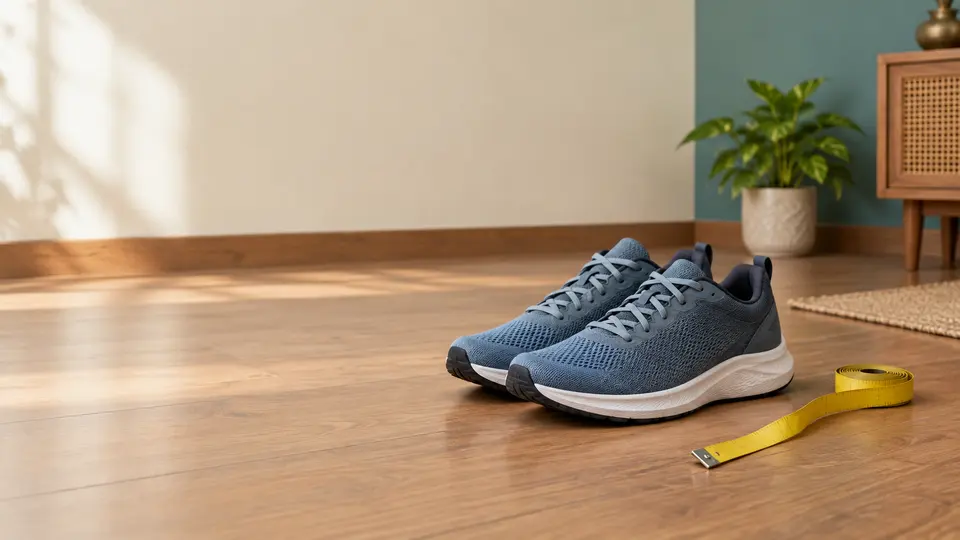
Running Warehouse describes the tracing method in plain steps. Stand on a sheet of paper in the socks used for running, keep the weight balanced on both feet, and draw a thin line around the foot with the pen held perpendicular to the ground.
ASICS adds a wall. The heel goes against it, both feet are traced, and the distance from the heel to the longest toe is measured in centimetres.
Both feet need a tracing, since the left and the right foot are rarely identical. The longer outline decides the size, and a brand chart in centimetres can be read straight against it. The paper can also be kept for comparison with the inside of a shoe.
Allowance rules compared
A foot outline gives only the base figure, and each source then adds room in a different way. ASICS adds 1 to 1.5 cm to the measured foot length, so the foot has space to expand during a run. Running Warehouse skips the centimetre figure and describes a good fit as half to a full thumb’s width in front of the toes.
RunRepeat works on the shoe, not the foot. Its rule is that the internal length of the shoe should be at least 5 mm longer than the foot.
The ASICS rule suits a buyer who has traced the foot at home and holds a brand chart in centimetres. The thumb test suits trying shoes on in a store. RunRepeat’s figure is the hardest to use when ordering online, as it needs a brand to publish the inside length of the shoe.
Every rule above comes from a footwear retailer, a review site or an ASICS page written for another country, and none of them makes a claim about foot health.
Settle length before width
When the length feels right but the fit still bothers, RunRepeat says the foot probably needs a different width. Width labels also vary by brand, so a step of roughly 3.18 mm between one width and the next does not hold for every maker.
For men, Running Warehouse lists the widths as Narrow (B), Medium (D), Wide (2E) and Extra Wide (4E), and says most runners find the standard width comfortable. ASICS uses the same 2E and 4E labels for men’s wide and extra wide in its guide for wide feet.
Pressure along the sides leaves two choices. Moving up a size adds length the foot may not need, while a wide version of the same shoe fixes the width, and most Indian brand listings do not offer one. Width is considered only after a pair of the right length has been worn, since changing both at once hides which change helped.
RunRepeat gives a checklist for the moment the shoe is on the foot:
- The heel is locked in.
- The midfoot is snug but not tight.
- The shoe feels right from the box, without relying on a break in period.
Size listings on Skechers India
The Skechers GO RUN Persistence and the Skechers GO RUN Consistent 2.0 serve here as examples of what Indian size listings look like. Skechers India lists sizes in US numbers, and its India and UK size field reads “null” on the listings for these shoes. No conversion table is printed here for that reason. A traced outline in centimetres, held against the brand’s own size chart, is the safer reference.
Consistent sizes are shown in US numbers from 7 to 14, and no width is stated. The size chart link is the only route to a centimetre figure.
It has stretch laces and a Hands Free Slip ins design, and weighs 11 oz in men’s size 9. Its heel measures 3 cm. Neither Skechers listing states a width, so for both shoes the width signs above are the main guide.
GO RUN Persistence: insole and stack height
The Persistence has a removable Arch Fit insole. An insole that comes out can be laid on the traced outline to compare the two at home, although Skechers does not suggest this use.
It is a lace up with an engineered mesh upper, weighing 238 g in men’s size 9. Skechers gives a stack height of 28 to 34 mm.
Sizes are shown in US numbers, no width is stated, and the India and UK size field reads “null” here too.
ASICS says its stores offer a FOOT ID fitting service.