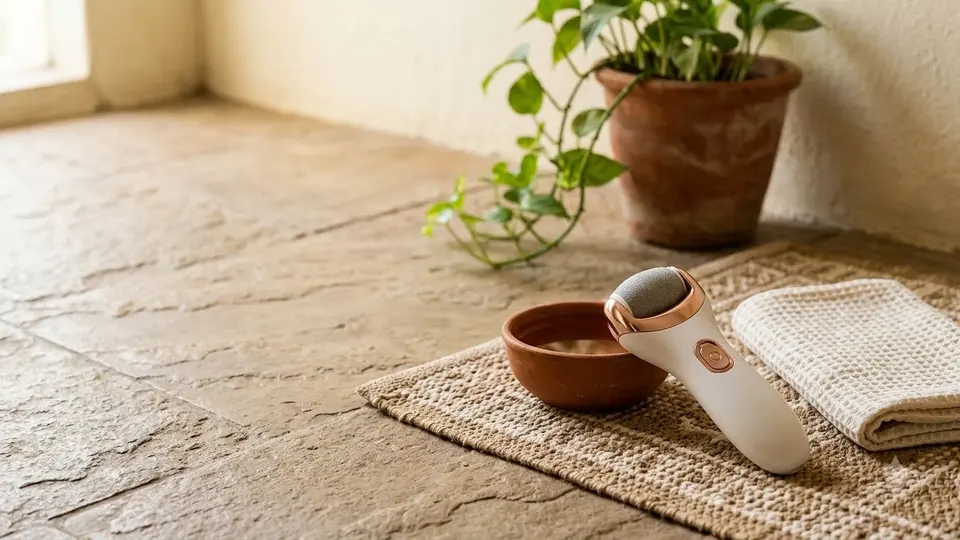
For a healthy adult, the NHS describes the home routine for a callus as soaking the skin in warm water, filing it with a pumice stone or foot file, and moisturising afterwards. An electric callus remover does the filing step with a motor that turns an abrasive roller against hard skin on the heel and sole, and it does not replace the soaking or the moisturiser.
The three rechargeable roller models sold in India here, the Winston WCR-101, the Vandelay CQR-FC800 and the Lifelong LLPCW105, differ in how many heads come in the box, what the page says about water, and how long one charge lasts.
Why heels crack
The NHS says corns and calluses come from pressure or rubbing on the skin of the hands or feet. For heels, it lists high heels, wrong size or tight shoes, and bone problems in the foot among the triggers, along with losing fat under the sole with age.
A roller removes hard skin that has already formed. It does nothing about the pressure behind it, and the NHS advice to avoid tight, pointed shoes and long spells of standing applies whichever tool is used.
Open heels on dry days and walking barefoot on rough floors are common in India, though neither is on the NHS list, and no brand page makes a claim about them.
Medical check before buying
People with diabetes should ask a doctor before using any of these devices. The NHS says people with circulation problems, a weakened immune system, and older people should also see a GP or foot specialist instead of treating a callus themselves.
A Kent NHS diabetes foot care leaflet says never to treat corns and calluses with sharp blades, corn plasters or hard skin removing creams. None of the three product pages carries a warning of this kind for people with such conditions, and the Winston page calls its device safe for all skin types without citing a test.
Winston WCR-101 and Vandelay CQR-FC800: batteries and heads
The Winston WCR-101 is a lithium ion unit with two 360 degree rotating rollers, one fine for daily use and one coarse for old, thick callus. The battery is 500 mAh, with a USB charge of about 2 hours, and working time of about 120 minutes.
A 1 year replacement warranty is stated as well, which is a firmer term than the Lifelong page offers. The box list names a charging cable, a cleaning brush, a manual and one additional grinding head.
The Vandelay CQR-FC800 carries a 1200 mAh battery, and its listing says a charge of 2 hours gives 6 to 7 hours of use. That is the longest run time among the three, as printed. The listing adds a 1 year warranty and a USB charger.
Three heads are named, a fine, a regular and a coarse one, and a single button raises speed and intensity each time it is pressed. The listing says to stop if the skin shows redness or cutting.
Lifelong LLPCW105: the box and the title
The Lifelong LLPCW105 is sold as a 14 in 1 unit, although its box holds one remover, three heads, a manual and a warranty card. The page does not explain the other functions in the title.
It describes the heads as coarse, regular and fine in one place and as rough, medium and fine in another. Charging takes about 3 hours over USB, and the page gives up to 120 minutes of run time. Speed settings are not stated, and neither is the length of the warranty.
The page lists a weight of 370 g and a case that measures 19.5 x 14.2 x 6.7 cm. These are the only figures among the three that describe the size of the body, and they matter to a buyer who wants a unit that sits easily in one hand.
Roller grit
No page gives a grit number. Every brand uses words, and the words change from page to page, so a coarse roller from one brand cannot be matched to a coarse roller from another.
Winston has the shortest ladder, with a fine roller for daily care and a coarse one for thick callus. The other two offer a third head in between, which suits a user who wants a step between smoothing and heavy filing.
The Vandelay page calls its third head the coarse black roller. No page states how long a head lasts before it needs replacing.
Wet or dry use
Water statements vary more than any other detail. The Vandelay listing gives IPX4 water resistance and says not to submerge the unit, while also telling the user to soak the feet fully before use.
The Winston page calls the rollers waterproof and tells the user not to wash the whole unit, with no rating for the body. Lifelong uses the word waterproof in its title and water resistant in the body, with no rating either way.
A buyer who plans to use the device in the shower will find no usable figure on two of the three pages, and the one figure, IPX4, comes with the instruction not to submerge.
IPX4 covers splashes from any direction. It does not cover immersion, so rinsing the roller head under a tap and wiping the body is the use that fits the Vandelay wording.
Battery and charging
All three models are rechargeable, and all three charge through a USB cable or a USB input. None runs on replaceable cells, so the choice here is between charge time and run time.
Winston charges in the shortest time, about 2 hours for about 120 minutes of use. Vandelay charges in the same 2 hours but states a much longer run time, which is the largest gap between charge and use in the group.
Lifelong takes about 3 hours to charge and gives up to 120 minutes of use. The Lifelong page names no battery capacity, and no page mentions a charge indicator.
A callus remover is used for a few minutes at a time, as the Winston page suggests with a 2 to 3 second glide over the target area. At that pace a 120 minute battery covers many sessions, so run time is a less pressing detail than it first looks.
Battery capacity is stated on two pages only, 500 mAh for the Winston and 1200 mAh for the Vandelay.
Speed settings
Winston states two speed modes. Vandelay uses one button that steps up speed and intensity without saying how many steps exist.
Lifelong gives no speed information on the page that was opened. A higher speed removes skin faster on the same grit, so a buyer with thin heels may prefer a low mode, while thick callus on the heel edge is the case a high mode is written for.
Speed is also tied to pressure. The Winston page asks for a glide of 2 to 3 seconds and not a press, and no page gives a pressure limit.
Spare rollers and box contents
The Winston box lists an additional grinding head, which is the only spare named. The Lifelong box holds the unit, three heads, a manual and a warranty card, and the Vandelay page mentions three heads and a charger.
A cleaning brush is packed with the Winston as well. Lifelong lists a cleaning brush in one feature section but not in its box contents, so a buyer would want to confirm what arrives with the seller.
Replacement heads sold on their own are not described on any of the three pages. A user who wears down a roller may therefore need to buy a new unit, which is worth weighing against the stated warranties.
Care after use
The Winston page tells the user to rinse the skin or use a wet towel to remove dead skin particles after filing. It supplies a cleaning brush for the roller, and the Vandelay listing asks the user to avoid physical damage to the device.
Hard skin dust collects on the roller surface, so each brand page implies some cleaning step, though only Winston describes one. None of the pages gives a storage instruction.
A rotating head is also the idea behind the brush described in the facial cleansing brush guide, though that product is made for the face and works on a different grade of skin. The foot units here use a coarser roller, and the two are not interchangeable.
Readers who already own a device from the epilator guide will find the same pattern of USB charging and wet use claims, and the same need to read the water figure on each page. The facial steamer guide covers a different kind of home skin care, one that uses warmth and not abrasion.
Electric or manual file
The NHS names a pumice stone or foot file for routine care, and it says nothing about powered tools. A manual file has no battery, though it demands hand effort over a longer session.
An electric unit saves that effort and adds a roller that turns at a fixed speed. The Kent leaflet advice against sharp blades does not mention rollers, and a doctor can say which method suits a particular foot.
Skin that bleeds, shows pus or becomes very painful is a matter for a doctor, as the NHS says.