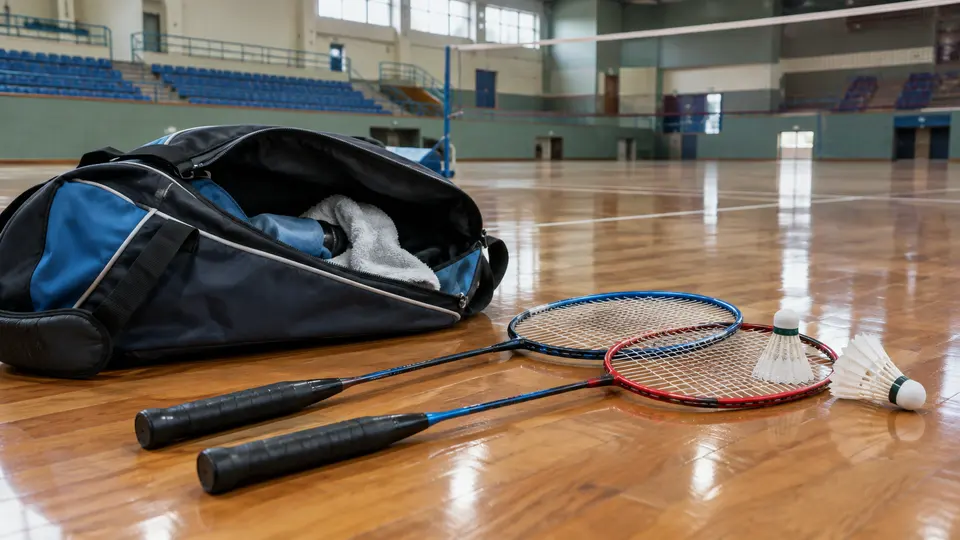
Two formats cover the best badminton racket for beginners in India, a pack of two or a single racket, and all four rackets here are sold strung. Li Ning sells aluminium frames in packs of two with full covers, Apacs sells one strung racquet with a head cover, and Yonex sells a graphite frame with a G5 grip.
XP-60-IV: a pack of two with covers
The frame is aluminium and the rackets arrive strung, with a full cover for each one. Two casual players can open a single pack and begin a game, as a new player needs someone on the other side of the net.
Covers are where the pack does better than the other two brands. The Apacs has a head cover, and Yonex does not mention a cover for the Astrox 77 Play at all. Li Ning sells the XP-60-IV in black and pink.
Li Ning publishes no weight, balance or grip size for it, and beginner guides spend most of their space on those points. A player who already knows that a particular weight or balance is wanted has nothing from Li Ning to compare.
The XP-80-IV in grey and blue
On the published details, the XP-80-IV is the same offer as the XP-60-IV. It is a pack of two strung aluminium rackets with full covers, and the colours are grey and blue.
Li Ning does not explain how the two models differ, and the model numbers say nothing about weight or balance. Nothing published places one model above the other, and the XP-60-IV is named as the pick only to give the group a single lead.
Apacs G Fire 200 as a single racket
The Apacs G Fire 200 is a single strung racquet with a head cover, in black and fluorescent orange. It fits a first time player whose partner already owns a racket, and it brings a second brand into the comparison.
Apacs does not name the frame material, which leaves it behind the two Li Ning packs on detail. Weight, balance and grip size are missing for it as well.
Astrox 77 Play and its level label
Yonex describes the racquet on its US storefront as built for “intermediate to advanced players”. That storefront also files it under a beginner label, so the two descriptions do not agree, and neither is an Indian rule or recommendation.
More is known about its build than about the Apacs. Yonex gives it a graphite frame and a G5 grip, the only grip size stated in this group, and it is sold strung.
The racquet suits a player who wants a graphite Yonex and is willing to move up from beginner level. No cover, weight or balance is published for it.
Weight and balance in the beginner guides
Active SG, the sport agency of Singapore, says lightweight rackets are highly recommended for beginners. Its guide suggests the 3U class, which it gives as 85 to 89 g.
Li Ning treats weight and balance as two separate matters. Its guide says the balance point is not directly related to weight, so a heavier racket can still be head light, and a lightweight racket can be head heavy, even or head light.
Active SG separates rackets by where the weight sits. Head heavy rackets add power for shots played from the back of the court, while head light rackets are easier to control and quicker at the net.
A racket can be light and still balance towards the head, so a weight class says little about where the balance sits, and a balance point says little about weight.
An even balance sits between the two. Active SG calls it a good starting point for a beginner who has not settled on a playing style, and Li Ning reaches the same place from the other side, saying beginners should generally begin with a balanced racket.
Active SG points a player who expects to hit mostly from the back of the court towards a head heavy frame, and one who expects to spend more time at the net towards a head light one. The beginner who cannot yet say is the case both guides cover with the even balance.
None of the four rackets has a published weight or balance, so none of them can be placed against this advice. Li Ning, the maker of the first two rackets, wrote one of the two guides, and Active SG gives the same advice on balance.
Strung rackets and string tension
All four rackets are sold strung, so stringing does not separate them. Yonex uses the same marker on its US storefront, where the beginner collection lists 20 racquets and many of the names carry the label STRUNG.
Li Ning says the strings of an unstrung racket add about 4 to 5 g to the head. A weight quoted for a bare frame is therefore a little lower than the weight in the hand once the strings are fitted.
Active SG gives a starting tension for beginners and adds that the tension a player needs may vary with climate. The string tension of the four rackets is not published, so that figure cannot be compared with any of them.
Neither guide takes a position on whether a beginner should buy a racket already strung.
Rackets needed and player level
The number of rackets needed settles the first point. Two players starting together are covered by one Li Ning pack, and a player whose partner already owns a racket needs only the Apacs.
Player level settles the second. The aluminium Li Ning rackets and the Apacs are the beginner options, and a player ready to move up is closer to the graphite Astrox 77 Play.
Weight and balance settle nothing on the published details. A player who has not yet chosen between power from the back and control at the net falls under the even balance advice.
Grip size points to a single racket, since only the Yonex has a stated grip size, G5. The same is true of a graphite frame, which only the Yonex names.
Frames, packs and covers compared
Frame material divides the group most clearly. The two Li Ning models are aluminium and the Yonex is graphite, while Apacs names no material.
Pack size differs too. Li Ning sells both of its models as a pack of two, and the Apacs and the Yonex are single racquets. For two members of a household starting together, one Li Ning pack covers both, while the Apacs or the Yonex would have to be ordered twice.
Each Li Ning pack includes two full covers, the Apacs includes a head cover, and no cover is mentioned for the Yonex. Colour is named for three of the four, with the Yonex as the exception.
Grip size is stated only for the Yonex. No shaft stiffness is published for these rackets, and the guides from Active SG and Li Ning used here do not cover it.