The Central Pollution Control Board (CPCB) places a 24 hour PM2.5 reading of 121 to 250 in its Very poor band, and anything above 250 in the Severe band. An air purifier for bedroom use is meant to bring such readings down, and only two of the four units here, the Philips AC0951 and the Dyson, carry a PM2.5 sensor to report them.
Noise decides a bedroom purifier more than airflow does. Xiaomi is the sole brand here to give a decibel figure for sleep mode, and the EPA guide says noise may be a problem with portable air cleaners that contain a fan.
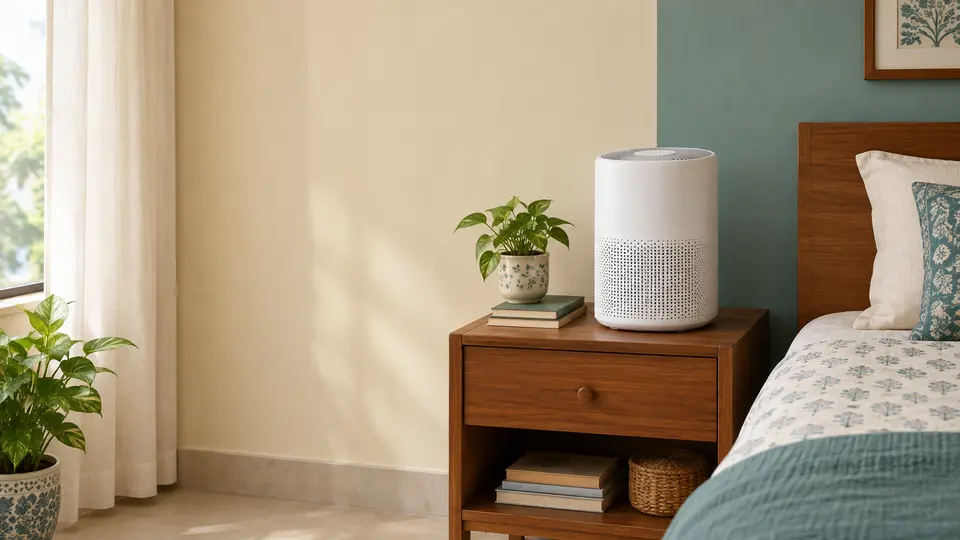
The unit, model AC-M18-SC, draws 27 W and carries a pre filter, a HEPA filter and activated carbon. Xiaomi states a rated particle CADR of 230 as a brand claim, and it positions the unit as a compact model for a single bedroom that works through the Xiaomi Home app.
None of the other three purifiers prints a decibel figure for any mode. Xiaomi states no filter life or warranty term for it. Its room coverage claim also does not match its own formula.
Philips AC0951: PM2.5 sensor and conflicting claims
This compact unit has a PM2.5 sensor, app control and a sleep mode. It lists HEPA, active carbon and a pre filter, the same three layers as the Mijia, with a CADR of 250 that sits between the Mijia and the AC1711/61.
Philips gives a maximum draw of 23 W and a standby draw under 2 W.
Its own claims disagree with each other. Coverage is headlined at 30 sq m and later listed as a maximum of 65 sq m.
The warranty is written as 2 years in one place and 3 years in another. Noise and virus claims appear in the highlights, and the specifications do not show them.
Dyson publishes no CADR and says the measure does not reflect performance in a real room. It describes a whole room test in an 81 cubic metre space in its place.
What Dyson does state is a sealed HEPA H13 standard with activated carbon, real time PM2.5 readings and a night mode. Those filter facts are the main case for the Purifier Cool, and no other purifier here names both a sealed HEPA H13 standard and a night mode.
The Dyson page gives no model number, airflow, decibel level or warranty term.
AC1711/61 and its sparse specifications
Philips states a CADR of 300 for the AC1711/61, the highest of the three published figures. It is a mid size unit, and the specifications add dimensions of 273 x 273 x 486 mm and a warranty of 2 years.
Filter layers, a night feature, room coverage, decibel level, filter life and power draw are all absent. Some of the fields on the page read like a template for a steam product.
A unit may not reach its rated output in every circumstance, as per the EPA guide, and brands fill that gap with coverage claims of their own.
Xiaomi headlines 400 sq ft for the Mijia.
Its own formula divides the CADR by a ceiling height of 2.4 m and 2 air changes, and the result is about 48 sq m.
Ceiling height is one of the two inputs, so a bedroom with a different ceiling gives a different area.
Two measurements decide how a coverage claim reads against a real room: the floor area of the bedroom in square metres and its ceiling height. Placement adds two more, the distance from the bed to the unit, against the one metre Philips India suggests, and the free space around the wall side, against the clearance needed for the inlet and outlet.
The three stated CADR figures run from 230 to 300 cubic metres per hour. The Mijia sits lowest and the AC1711/61 highest, and Dyson cannot be placed in that order, since its 81 cubic metre test room is the only size reference the brand gives.
Filters and ozone
Every filter claim comes from the brands. The Mijia and the AC0951 list HEPA and carbon behind a pre filter, the same three layers in a different order, and Dyson names a sealed HEPA H13 standard with carbon.
For the AC1711/61, Philips describes no filter layers, so that model cannot be compared on this point. The EPA guide says air cleaning alone cannot remove all indoor pollutants.
The Philips India explainer on allergies treats a purifier as a way to reduce PM2.5, dust and pollen, and it does not present one as a cure. Dyson, for its part, ties its filter claim to a sealed HEPA H13 standard and to activated carbon.
Ozone is the other feature to know about. The EPA guide says ozone has little effect on most indoor contaminants at levels that meet the public health standard.
Night use, placement and warranty
Sleep mode is listed for the AC0951 and the Mijia, and Dyson lists a night mode. The AC1711/61 states no night feature.
App control is listed for the AC0951 and the Mijia, and the Xiaomi Home app is the one named for the Mijia. A PM2.5 sensor is listed for the AC0951 and the Dyson.
Filter life is stated by Dyson alone, with replacement every 12 months. Philips gives none for the AC1711/61, and Xiaomi gives none for the Mijia.
Philips India suggests keeping a bedroom unit about one metre from the bed and away from the wall. It adds that the inlet and outlet need a clearance of 15 to 20 cm around them.
Power draw is listed for only two of the four, at 23 W for the AC0951 and 27 W for the Mijia, and the AC1711/61 lists none.
Printed warranty terms separate the four in a plain way. The AC1711/61 shows a single term, the AC0951 shows two terms that disagree, and Dyson and Xiaomi state none.
Air quality index bands
The CPCB National Air Quality Index table describes the Very poor band, an index of 301 to 400, as possibly causing respiratory illness on prolonged exposure.
Above it, the Severe band of 401 to 500 is described as possibly causing respiratory effects even in healthy people.
The CPCB table also carries 24 hour bands for PM2.5, the pollutant that the AC0951 and Dyson sensors report. The Good band on that scale runs from 0 to 30. Arthapedia, a resource of the Indian Economic Service, agrees on the six categories and says the index covers eight pollutants.