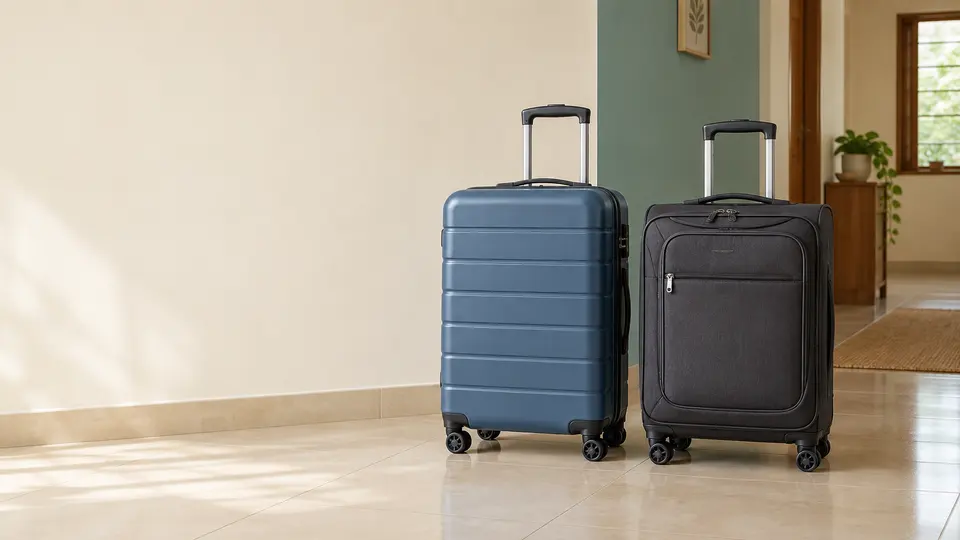
Among the three medium bags, Safari states up to 25 percent more capacity from an expander, VIP lists an expander with no figure, and Mokobara mentions none.
That gap matters in a hard vs soft luggage decision for a mixed train and flight trip, because expansion is a feature of the two soft bags here, and neither Safari nor VIP publishes the extended size.
Railway size and weight limits
Indian Railways lists a suitcase size for AC 3-Tier and AC Chair Car, and its rules are silent on shell type. The listed size is 55 x 45 x 22.5 cm, labelled as length, breadth and height without saying which edge of a bag each one means.
Weight is the looser line. In those two classes the free allowance and the maximum are both 40 kg, well above what one medium bag will hold.
Other classes carry different limits. AC 2-Tier is listed at 50 kg free and 100 kg at most, and Sleeper has the same free figure as the chair car, with 80 kg at most.
The size line covers the two classes named at the start. Whether the same size applies in Sleeper or other classes is not said, so a traveller who rides those classes would need to confirm the rule with the railway.
Airline limits on checked weight and size
Domestic airlines work on weight and total size. Akasa Air and SpiceJet list one checked piece of 15 kg, and IndiGo lists 20 kg.
Akasa Air and SpiceJet both state a limit of 158 cm for length, width and height added together. IndiGo shows a size figure too, but its layout leaves unclear which bag it applies to.
Under airport restrictions, the same two airlines add that no single bag may exceed 32 kg. Akasa Air lets a student fare check a single bag up to 25 kg.
SpiceJet states no rule on hard or soft bag type.
Safari Select Panorama: weight, volume and expander
The Select Panorama is the lightest of the three when empty, at 2.90 kg, and the largest by volume at 82 L. On the lower airline allowance, that leaves about 12.1 kg for contents, by subtraction from the listed weights.
Its expander gives up to 25 percent more packing capacity. Safari does not list dimensions with the expander extended, so the total after expansion is not known.
Safari calls the polyester water and dust resistant, and the bag has a TSA approved lock and dual wheels.
Its warranty period is not given in text, only as a link to the Safari warranty policy. The title tag and meta text also disagree on the range of sizes.
VIP ALFA with the zip line lock
The VIP ALFA is a polyester medium with a flushed combination lock set into the zip line and 360 degree wheels. It is the expandable soft bag of the two, for a traveller who wants the lock built into the zip.
Empty, it weighs 3.6 kg, which leaves about 11.4 kg of contents on the lower airline allowance, and its capacity is 68 L. VIP lists an expander but gives no capacity figure for it, and no dimensions with the expander extended.
The bag has two compartments, one pocket and three zips, and the feature text mentions a croc teeth zipper.
VIP’s own entry gives two different warranty terms, so neither is stated here. Its rain cover field shows a spreadsheet error, and no water resistance claim is repeated for this bag.
Mokobara Transit: polycarbonate shell and weight
On the numbers, the Transit gives the least for a mixed trip. It weighs 4.06 kg empty, holds 65 L and has no expander mentioned, so its capacity is the listed figure alone.
That leaves about 10.9 kg of contents on the lower airline allowance. Mokobara makes the hard bag, a German Makrolon polycarbonate hardshell with eight Hinomoto wheels, a one push TSA approved lock and a 3 year warranty.
Those features suit a traveller who accepts a heavier empty bag in return for a rigid shell. Mokobara lists no exclusions for the warranty, and only the airline damage cover has an exclusion list.
A separate 1 year airline damage cover applies to this bag. It excludes theft and loss, overpacking, wear and tear, scratches and scuffs, heat, fire and chemicals, and commercial use.
What each shell offers
Travelpro, a luggage brand, says hard side bags give the contents maximum protection and can withstand rough baggage handling. Its guide adds that they cannot be compressed, which can make them harder to fit in crowded overhead compartments.
Soft side bags are not as rigid, according to Travelpro, but are easier to stow as carry on. Samsonite India recommends soft sided carry ons that have a rigid structure, since they expand and contract more freely than hard shells, and it makes that statement about carry ons only.
These are manufacturer statements and not test results.
Shell materials from polypropylene to ballistic nylon
Materials differ within each type. Travelpro calls polypropylene the lightest hard material but not as rigid as polycarbonate, and says polycarbonate resists cracks, scratches and impact while costing more and being more difficult to repair.
Among fabrics, nylon resists tears and abrasion better than polyester, and ballistic nylon is named the most durable. Polyester is described as lightweight, flexible and durable.
The VIP and the Safari are polyester, and the Mokobara is polycarbonate.
Size against the stricter leg
A family that takes a train for one stretch and a flight for another needs a bag that satisfies the stricter leg, and size is the tighter line. Each of the three medium bags is longer than the railway’s listed length, whichever shell it has, and the smallest measure printed for each is above the listed height as well.
The railway line is the harder one to read, because its three figures are not matched to the edges of a bag. Samsonite India’s size chart shows a similar spread between medium and large checked bags, though it does not label which number is which edge.
Two measurements settle the question once a bag is packed. The first is its weight on a home scale, set against the lower airline allowance, and the second is length, width and height added together, set against the Akasa Air and SpiceJet total. With an expander in use, the extended size is the one to measure, since neither brand publishes it.
For flights, arithmetic from the listed sizes gives the VIP a total of 140 cm and the Safari and Mokobara 134 cm each. All three sit under the Akasa Air and SpiceJet limit.