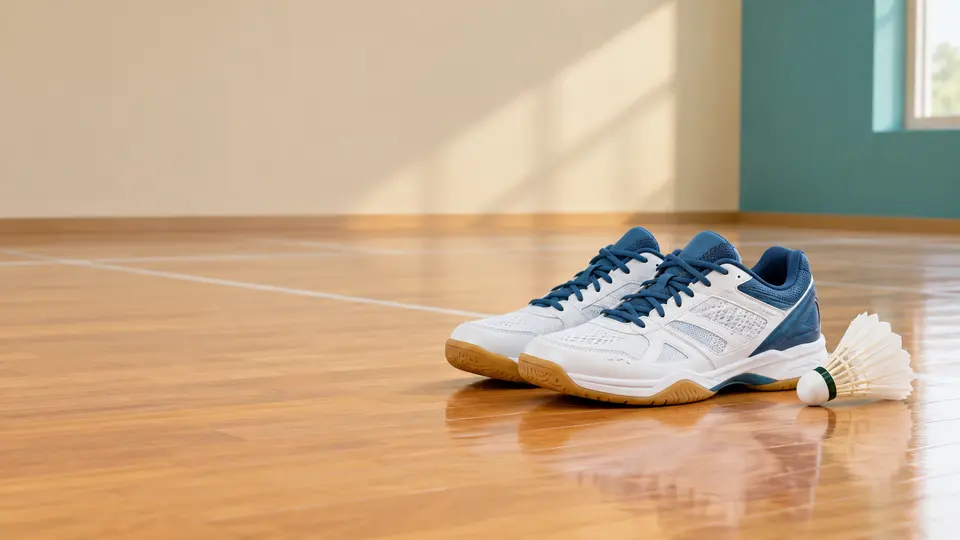
ASICS, a sports footwear maker, publishes a guide to court shoes, and the four pairs here are read against it. Listings for the best badminton shoes in India differ in how many of its points they state outright, from a named sole to a described midsole.
Three points from ASICS
ASICS advises a neutral badminton shoe with a relatively thin sole, which keeps the player stable and low to the ground. It also says to choose shoes that meet the specific needs of the sport, so a thick running sole is not the usual recommendation.
Grip is the second point; ASICS says grip stops a player slipping and injuring themselves, and it advises looking for 360 degree grip.
Cushioning is the third. In ASICS’s words, cushioning throughout the foot reduces the chance of injury and strain when landing from high jumps. Players also slide on court, so ASICS adds that the shoe has to support and protect the ankles.
Those points make a three point check: a non marking sole, a low and stable sole, and cushioning for landings. The guide comes from a UK brand site, so its advice is a manufacturer’s view and not a standards body’s.
The A170IN from construction to care
Victor is the only brand here that calls its pair entry level, and it describes the A170IN for beginners and recreational players. Sizes are unisex, from 6 to 11.5 in half steps.
PU leather and mesh make up the upper. The midsole combines EVA, ENERGYMAX and a nylon sheet, and the outsole is rubber with a nylon sheet for midfoot support.
Against the three point check, the cushioning is described and the outsole material is named. Victor does not say the outsole is non marking, and it gives no sole thickness, weight or last shape.
Victor says to use the pair only on indoor courts, wipe it with a soft damp cloth and air dry it away from direct heat. No other brand here gives a care rule. Victor also lists wide foot models such as the A170 and the A170II.
The HY Court 3.0 sole and collar
Nivia states the sole most directly, with a non marking, multi directional herringbone outsole. The heel collar is a dual layer of high density foam, and the sockliner and inner insole are soft NR EVA.
The shoe is a lace up pair with a stitched toe, made in India. Nivia says it is crafted for badminton and other fast paced court sports.
Nivia also claims the foam is 15 percent more responsive than standard EVA, which is its own comparison. No weight, level or midsole material is given. Neither Victor nor Puma describes a collar or a sockliner.
A Nivia Mid Court badminton shoe is listed with Flexipro technology and a non marking sole, but without an upper or midsole, so it is not among the picks.
Li Ning Saga Lite II and its level field
A weight of 330 g is listed without saying for which size. That is the only weight stated for any of the four pairs.
PerfectFit technology is named for support and protection, alongside an Energy Returning Mid for shock absorption and energy return. Both are brand descriptions.
Under the product code AYTQ090-1-2.0, Li Ning says the shoe is designed to cushion and support the feet during training and play. It describes the shoe for beginners and experienced players, yet its player level field says Intermediate.
No upper, midsole or outsole material is listed.
Puma Ad Court positioning
A breathable mesh upper and a non marking rubber outsole come on this lace up shoe. Its heel is flat with a 0 mm drop, the width is regular and the pronation type is neutral, which lines up with ASICS’s preference for a neutral shoe.
Listed in the men’s badminton category and made in India, the pair comes with no midsole, weight or cushioning detail, and Puma positions it for on court and off court wear.
Its badminton range is described as having non marking outsoles, shock absorbing midsoles and breathable materials, but that text covers the range and not each model. Two other Puma models in the same category show why a tag proves little.
The Varion II is described as a versatile indoor shoe for handball courts and gyms, and the Deuce as a shoe for gym sessions or everyday errands. Dual positioning places the Ad Court nearer to those two than to a specialist badminton shoe.
Width, level and half sizes
A narrow shoe on a wide foot, or the reverse, undoes whatever the sole offers. Victor’s India shoe collection sorts its models into U shape, V shape and wide feet lines, and it does not explain the first two terms.
Victor also has level filters named Professional Badminton Shoe, Train and Entry, and none called Beginner. Only one model on the first page is labelled entry level.
Width is addressed only by Puma’s regular width label, and Victor lists wide foot models. Victor’s half sizes help a player whose foot falls between two numbers.
How the four score on the check
Nivia comes closest to a full score, with a stated non marking sole plus a foam heel collar and sockliner. Victor states cushioning and a rubber outsole, though not a non marking one.
Li Ning gives cushioning in the brand’s own terms and describes no sole. Puma states a non marking sole and says nothing on cushioning, so the last two pairs split the two halves of the check between them.
Low and stable is the point no brand addresses. No pair gives a sole thickness, and the flat heel on the Puma is the nearest thing to a stability detail.
Ankle support, which ASICS ties to sliding on court, is not discussed for any of the four.