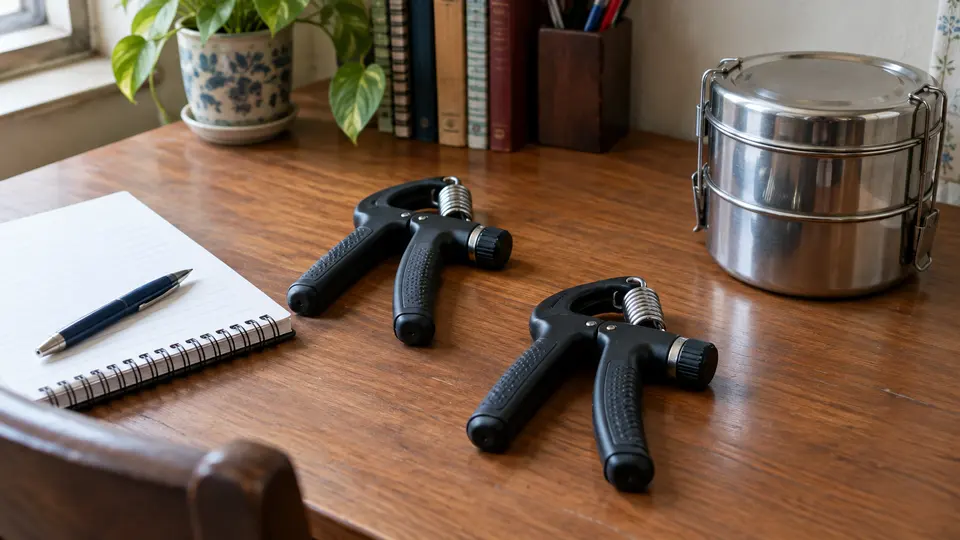
best hand grip strengthener for beginners: The Strauss grip with counter is the pick, starting at the lowest setting listed and stating its size and weight. Decathlon is the only one of the four with a warranty, and Nivia ranks last for beginners since it gives no size, weight or starting guidance.
Method: specifications and warranty are read from brand pages and Amazon listings, last checked 10 Nov 2026. Nothing here is lab-tested. How we pick. Site facts.
A first adjustable grip needs a starting setting, and no brand names one for a first time user. The best hand grip strengthener for beginners among these four therefore follows the lowest listed figure and the amount of detail each brand publishes, so the evidence behind any pick is thin.
Low start and light body on the Strauss
Strauss lists a range that starts at the bottom of the group and tops out at 60 kg. The body is plastic, stainless steel tension springs are mentioned, and the grip measures 11 cm in length and 15 cm in height. It starts at the lowest resistance listed, 5 kg, and states its size and weight, which two of the four do not.
Its top setting matches the Lifelong and sits above the Decathlon. At 130 g it is the lightest of the four with a stated weight, so a buyer who wants to carry the grip in a bag has the figures to judge it.
The title names a counter, though the retailer says nothing about what the counter does. The details come from GlobalBees, a retailer, and not from Strauss. How the resistance is adjusted is the main gap, and the width, warranty and any safety guidance are also missing.
A warranty on the Decathlon handgrip
Decathlon describes an ergonomic grip with textured handles and resistance set with an indicator. It describes the grip for hand strength training and for recovery use, in general terms, and these details are Decathlon’s own.
The narrowest range of the four belongs to Decathlon, with the lowest ceiling, so there is the least room to grow into. A stated warranty is what sets it apart. Decathlon is the only one of the four to list one, with a term of 2 years.
Material, handle size and whether the indicator is a counter are not stated. The range starts at 8 kg, and Decathlon gives no reason for that starting point for a first time user.
Lifelong LLFAHG01 and its rotation knob
The Lifelong LLFAHG01 is a small grip, at 15.5 x 8.8 cm and 150 g, with resistance set by a rotation knob. The body is listed as polypropylene, and the metadata of its product page mentions steel springs. Of the four, Lifelong gives the most construction detail.
Its range starts at 10 kg, the highest starting point of the four. That lowest setting is twice the starting point of the Strauss.
No counter or indicator is stated, and no usage or safety instructions are given. Lifelong lists no warranty, though it covers returns and replacement for damaged or incorrect items.
Lifelong’s page address carries the words “for all levels”. The text gives no instruction on what a level means or where to begin.
Nivia Xtreme Power Grip: the widest range
The Nivia Xtreme Power Grip, listed in red, names India as the country of origin and Freewill Sports Pvt. Ltd. as the manufacturer. It has a reinforced carbon steel spring, a nylon frame and an anti slip TPR grip.
Its tension is adjustable across a range far wider than the other three, with a ceiling far above theirs, and Nivia does not describe how the tension is changed.
Dimensions, weight, a counter, a warranty and usage or safety instructions are all absent, and the starting setting is the main gap for a first time user. The grip suits a buyer who expects to train hard as strength builds.
Strauss Adjustable Hand Grip Strengthener with Counter (Orange)
Resistance listed as 5 kg to 60 kg
Plastic body listed; stainless steel tension springs mentioned
Item length 11 cm, height 15 cm, weight 130 g
SuitsA buyer who wants a light grip with a counter named in the title and a lower starting resistance.
Keep in mindDetails come from the retailer GlobalBees, not Strauss, and do not say what the counter does, how resistance is adjusted, the width, the warranty or safety guidance.
SuitsA buyer who wants one grip with a wide range and is willing to start at the lowest setting.
Keep in mindMaterial, handle size and whether the indicator is a counter are not stated, and the 8 kg starting point is not explained for a first time user.
Lifelong Adjustable Hand Grip Strengthener (LLFAHG01)
Resistance listed as 10 kg to 60 kg, set with a rotation knob
Size 15.5 x 8.8 cm; item weight 150 g
Polypropylene body listed; the page metadata mentions steel springs
SuitsA buyer who wants a light, small grip with a knob to adjust resistance, starting from the lowest listed setting.
Keep in mindNo counter, indicator or warranty is stated, and no usage or safety instructions are given, though returns and replacement cover damaged or incorrect items.
Search on Amazon India Opens an Amazon India search for this model. Price and offers are shown there.
Reinforced carbon-steel spring, nylon frame and TPR anti-slip grip
Country of origin India; manufacturer Freewill Sports Pvt. Ltd.
SuitsA buyer who wants a very wide tension range and expects to train hard as strength builds.
Keep in mindThe very wide range gives no starting point for a first time user, and no dimensions, weight, counter, warranty or usage or safety instructions are given.
As an Amazon Associate I earn from qualifying purchases. Read the disclosure.
Resistance, body and weight of the four grips, with our pick first
Grip
Resistance listed
Body
Weight
Strauss with Counter (our pick)
5 to 60 kg
Plastic
130 g
Decathlon Adjustable Handgrip
8 to 40 kg
Not stated
Not stated
Lifelong LLFAHG01
10 to 60 kg
Polypropylene
150 g
Nivia Xtreme Power Grip
5 to 165 kg
Nylon frame
Not stated
Model Benchmark
4 verified models compared
4 verified models compared
4 verified models compared
Strauss and Lifelong compared
The Lifelong is the closest rival to the Strauss. The two share the same ceiling, and both are light, small grips.
Strauss starts lower and weighs less. Lifelong says how its resistance is adjusted, offers returns and replacement cover, and gives a body material and a size in centimetres.
A buyer who puts the lowest starting figure first will lean to the Strauss. One who puts a stated adjustment method and a stated return policy first will lean to the Lifelong.
Lowest settings and the step up
The lowest listed setting is the nearest thing to a starting point that any brand gives. Strauss and Nivia list 5 kg at the bottom, Decathlon begins at 8 kg and Lifelong at 10 kg.
A buyer who wants the lowest starting figure on paper finds it with Strauss and Nivia, and one who is content to begin a little higher finds it with Decathlon and Lifelong. None of the brands states how large the step is from one setting to the next, or how many settings sit between the lowest and the highest.
The top figures separate the grips more sharply. Decathlon stops at 40 kg, Lifelong and Strauss reach 60 kg, and Nivia lists 165 kg. The Decathlon has the least room above its starting setting, and whether that matters depends on how quickly strength builds. The Nivia range is wide enough to leave room for harder training, and the step up depends on the method of adjusting, which the brands treat unevenly.
No brand says anything on progression, and no listed setting is described as suitable for any particular person.
Adjustable grips only
All four grips are adjustable, and the set contains no fixed resistance model. What the brands do show is how each presents its own range, with a span of resistance in place of a single figure.
How the resistance is adjusted
The mechanisms differ from grip to grip. On the Decathlon an indicator sets the resistance, and the Lifelong uses a rotation knob. Nivia lists adjustable tension without describing how it changes, and Strauss does not say how its resistance is adjusted at all.
Three of the four mention springs: Nivia lists a reinforced carbon steel spring, and Strauss mentions stainless steel tension springs. For Lifelong the steel springs appear only in the metadata of its page, and Decathlon names no internal parts.
Brands also differ in how they address the buyer. Nivia gives no usage instructions, and Strauss gives no safety guidance, so a beginner who reads all four finds a description of the tool in each case and very little about how to use it.
Counters, handles and materials
Two of the four touch on a tracking feature without explaining it. Strauss names a counter in its title, and Decathlon describes an indicator that it does not identify as a counter. Lifelong and Nivia state neither, so a buyer who wants to follow rising levels over time would need to confirm what the Strauss counter and the Decathlon indicator do before ordering.
Surface is described for two grips: Decathlon lists textured handles, and Nivia lists an anti slip TPR grip. Neither gives a handle size.
Body materials are named for three: Nivia lists a nylon frame, Lifelong lists polypropylene and Strauss lists plastic, while Decathlon names no material. None of the brands compares how these materials wear over time.
Size and weight are stated for only two of the grips. Lifelong gives its size in centimetres along with a weight, and Strauss gives length, height and weight. The Decathlon and the Nivia give no measurement.
Warranty and safety information
None of the four product pages carries usage or safety statements. The text makes no medical claims, and none of the brands says which resistance suits a person with an injury or a hand condition.
Decathlon alone lists a warranty, and its term is the only one shown. Lifelong covers returns and replacement for damaged or incorrect items, while Nivia and Strauss state no warranty.
Frequently asked questions
What resistance should a beginner begin with on a hand grip?
No brand in this guide names a starting setting for a first time user. The lowest setting an adjustable grip offers is the nearest guide, and none of the brands explains why its range begins where it does.
Are adjustable hand grips better than fixed ones for beginners?
The brands do not compare the two types, so the question cannot be settled from what they publish. Each adjustable model lists a span of resistance in place of one figure, and that span is the detail a beginner can compare.
What is a hand grip strengthener used for?
A hand grip strengthener is a spring based handle that is squeezed against adjustable resistance. Brands describe it for hand strength training and recovery use, in general terms.
Do hand grip strengtheners come with a warranty?
Only one of the four grips in this guide lists a warranty, with the term shown in its product details. The others state none, although one brand covers return and replacement of damaged or incorrect items.
FitnessBuying decisionBest resistance bands in India: tube, loop or hip bandThe Boldfit Resistance Tube Set of 11 is the pick, a natural latex kit with handles and a door anchor for full body work at home. A long loop suits pull up assistance, a fabric loop suits glute work, each brand states its own kg figures, and the Nivia pack ranks last.5 products compared · 4 min read→FitnessTop picksBest gym gloves in India for lifting and wrist supportThe Boldfit Lifting Grip Bold is the pick, the only glove here with a padded leather palm and thumb loops that carry a neoprene wrap. The Nivia Scorpion is the one with stated sizes from S to XL, and the Lifelong half finger glove ranks last.4 products compared · 6 min read→FitnessBuying decisionBest adjustable dumbbells in India: dial vs plate setsThe Flexnest Flexibell, a dial dumbbell that changes weight in one move, is the pick. The Flexibell+ suits a lifter who expects to outgrow it, and the Domyos kit is the loadable option with a carry case. The PowerMax comes last, because its label and its plates do not match.4 products compared · 4 min read→FitnessTop picksBest home gym equipment for small space in IndiaThe Lifelong LLPB03 doorway bar is the pick for a small rented flat, mounting without drilling and leaving the floor free. The Lifelong stepper is the cardio item with the smallest stated footprint. One item of each kind covers the NHS aerobic and strength targets, and the Lifelong walking pad ranks last for the floor it takes.5 products compared · 5 min read→FitnessBuying decisionBest skipping rope in India for flats and terracesThe Domyos JR500 is the pick, a 3 m rope with an adjuster and rubber handles that lets a beginner run Nike's stand on the rope length test at home. The Domyos speed rope is the one made for smooth indoor floors, none of the four states the cable Nike suggests for concrete, and the Nivia pack of 2 ranks last.4 products compared · 4 min read→FitnessTop picksBest Badminton Racket for Beginners in India: Strung Options ComparedThe Li Ning XP-60-IV is the pick for a beginner, a pack of two strung aluminium rackets with two full covers. The Apacs G Fire 200 is the alternative for a player who wants a single racket. The Yonex Astrox 77 Play ranks last for a first racket, as Yonex describes it for intermediate to advanced players.4 products compared · 5 min read→