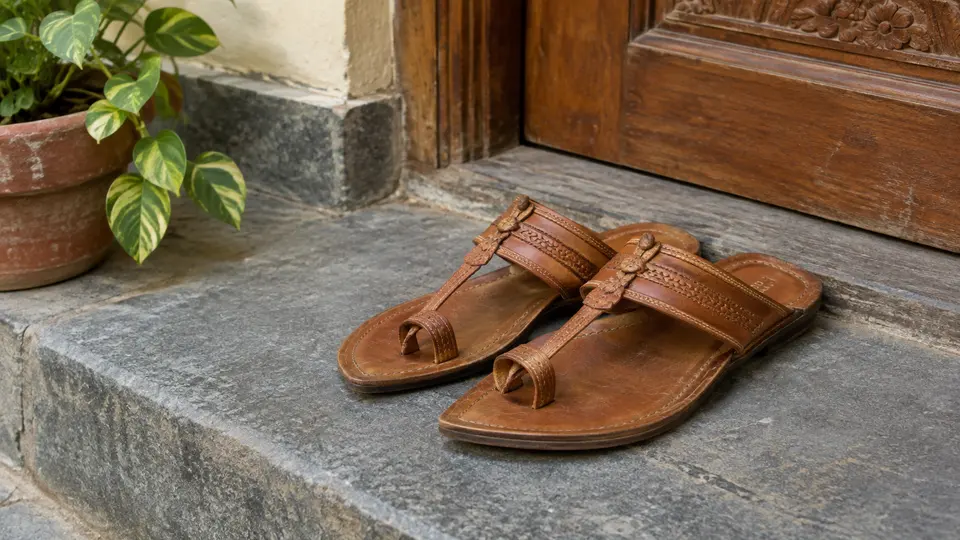
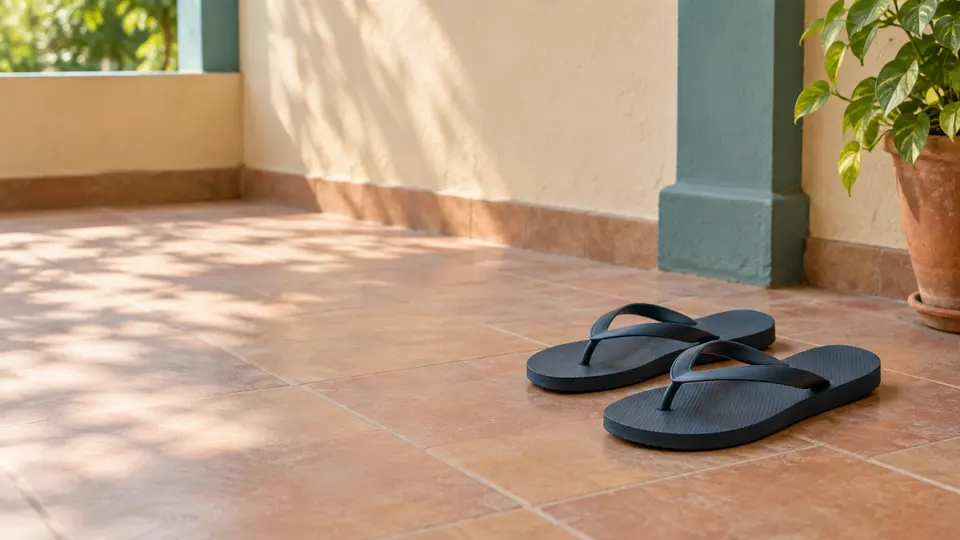
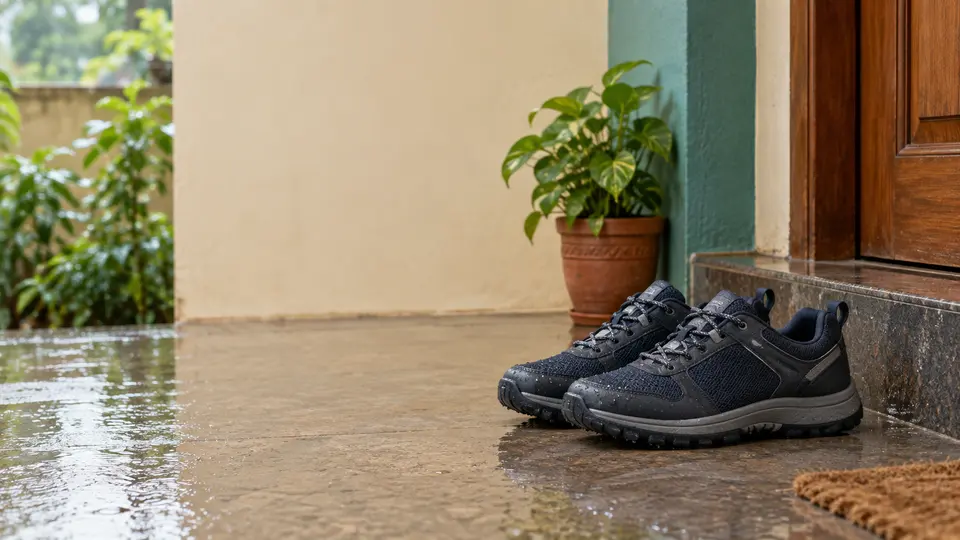
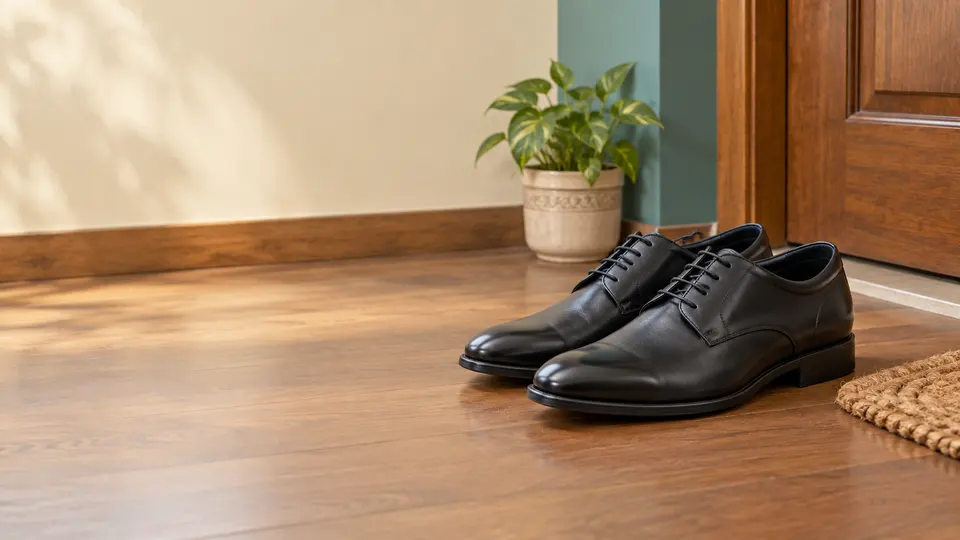
The public records and the brand pages for kolhapuri chappals do not describe the product in one voice. The GI journal and the Development Commissioner of Handicrafts word the leather differently, and the three brands size their pairs on three different scales, in Euro numbers, in plain numbers or with both together.
Coverage in the Free Press Journal describes Kolhapuri chappals as the traditional handcrafted leather footwear of Maharashtra and Karnataka.
Dmodot Pelle Kolho Nox: sole, warranty and returns
A rubber outsole of cemented construction is listed, with braided leather trim on the upper. The footbed carries a 3 mm Ortholite cushion. Sizes run from 40/6 to 45/11, with a Euro number and a UK number given together at each step.
The return policy sets a 7 day window for exchanges and returns. The item must be unworn, tried on indoors only, and sent back in original packaging with tags and the dust bag, and a return can be declined for misuse or improper care.
A 90 day warranty against manufacturing defects is described in the same policy. It excludes wear and tear, water damage, improper storage and misuse, so the water advice for the chappal also shapes what the warranty covers.
Care is simple. Dmodot says to keep the chappal away from water and wipe it gently with a dry cloth, and to avoid pulling the braided sections so that they do not loosen.
The product details carry one inconsistency. The outsole colour is black in the specifications table and dark brown in the FAQ, so a buyer who cares about the exact shade can ask the seller.
Two Kalapuri pairs
The first comes in a greenish grey and the second in Brown Dodge. Both use the same stitched TPR construction, so the choice between them rests on colour and on the name of the pattern.
Kalapuri describes the upper as leather over a stitched leather base and calls it genuine leather. That is the brand’s own statement and not a finding from any outside test.
Care advice is where Kalapuri says the most. The Punch Patta is not meant for water or the rainy season, and a pair exposed to water is to be dried fully. Kalapuri adds that leather can absorb moisture and lose its shape, and a wet pair belongs in the shade, away from hairdryers and direct heat.
For routine cleaning, the brand suggests dusting with a dry or barely damp cloth, avoiding any bending or folding of the sandals, and storing them cool and dry out of direct sun, under a cloth or in a shoe bag. Occasional leather conditioner or a natural oil such as coconut oil can be applied, according to Kalapuri.
The Kurundwadi comes with a full care guide that Kalapuri links without showing its contents. Neither pair has stated warranty terms.
Both are sold in Euro sizes 40 to 46, with UK equivalents in each size guide. The Punch Patta is the pair in a grey green shade, and the Kurundwadi is the same build in brown. Kalapuri accepts returns within 7 days of delivery if the sandals are unworn and unused, with tags and original packaging. Damaged, defective or wrong items are replaced at no extra cost, subject to stock.
Khadim Lazard and the missing return window
This slip on has a leather upper and a synthetic antibacterial lining. Khadim says the TPR sole gives slip resistance on dry and wet surfaces of all kinds, which is the brand’s claim.
Sizes run from 5 to 11, listed as plain numbers. Khadim advises avoiding washing and suggests a soft bristled brush or a microfibre towel for wiping off dirt.
No return window or warranty period is stated, and the only assurance is the phrase 100 percent Original Guaranteed, which is the brand’s own claim, with a link for creating a return.
Khadim’s policies say returns are for products that differ from the description, and the item must be unused and undamaged, with the original invoice.
Three soles, three kinds of care
The brands describe three different constructions, and the differences matter for daily wear. Kalapuri uses a TPR sole with a stitched kanpa, Khadim a slip resistant TPR sole, and Dmodot a cemented rubber outsole.
Kalapuri’s stitched kanpa is the construction word that sets its pairs apart from the cemented Dmodot outsole.
None of the four gives a sole thickness or a break in period. The construction words are the only guide to how each pair is built.
Care advice is closer to uniform than the soles. Kalapuri, Khadim and Dmodot all steer buyers away from water, so a chappal worn to a wedding or a festival in dry weather faces fewer risks than one worn on wet pavements.
Dry wiping appears in the advice from Kalapuri, Khadim and Dmodot alike. Kalapuri alone adds shade drying and storage in a cool place.
Sole, size and care by pair
Dmodot lists a rubber outsole and sizes 40/6 to 45/11, with the advice to keep the chappal away from water. Kalapuri lists a TPR sole with a stitched kanpa in Euro 40 to 46, and says no water and no rainy season.
Khadim lists a slip resistant TPR sole in plain sizes 5 to 11, and its care note is to avoid washing. Kalapuri links a full care guide for the Kurundwadi without showing its contents.
What the GI tag covers
The tag sits with LIDCOM in Maharashtra and LIDKAR in Karnataka, both state run corporations, according to the Free Press Journal’s coverage of the row with Prada. A second report from the same publication says the two state governments jointly secured the Geographical Indication (GI) tag, and that the status legally reserves the right to make and market Kolhapuri chappals.
Registry papers agree. The GI journal entry lists the same two corporations as applicants. It names the Central Leather Research Institute in Chennai as facilitator and files the product under footwear class 25.
The tag is held by the two corporations, so no shop or label owns it, and a brand name is a separate matter from the origin claim.
LIDCOM has introduced QR coded certification for each pair, and scanning the code can show the name and location of the artisan or production unit. A QR code or a mention of the artisan can be compared with what the seller says.
Where the craft is practised
According to the GI journal, the production area covers four districts of Maharashtra, namely Sholapur, Sangli, Kolhapur and Satara. In Karnataka it covers Dharwad, Belgaum, Bagalkot and Bijapur.
The Free Press Journal names Kolhapur as the main centre of production. The Development Commissioner of Handicrafts agrees on the town and adds that more than ten thousand artisans work there, a figure that is the government’s own.
Descriptions of the leather differ between the records. The GI journal says the chappal is made entirely from bag tanned vegetable leather, tanned with babul bark and myrobalan fruits, and that bag tanning takes about 30 to 32 days.
The handicrafts commissioner names buffalo hide, goat hide and cowhide as raw materials, with a buffalo leather sole and a goatskin upper. The two documents are worded differently, and a brand that names a leather type may use either description.
For stitching, the GI journal says the outer sole, insole, upper and heel are traditionally stitched with leather thread, and that some areas now use a latex pasting method. The crafts page says the full process can take up to six weeks and ends with cream polish and sun drying.
Sizing across the three brands
Each brand presents sizing in its own way. Kalapuri uses Euro sizes with UK equivalents, Khadim lists plain numbers, and Dmodot combines the two scales. Kalapuri suggests the larger size for a buyer between two sizes.
The GI journal gives no dimensions for the chappal, only size patterns. It lists grades 6 to 11 for men and 5 to 9 for women.
A measuring guide from Lusso Lifestyle describes a simple method. Paper is laid against a wall, the heel and the longest toe are marked, and the length is measured in centimetres, using the larger foot.
The same guide advises measuring in the evening, since feet swell during the day and morning readings can give shoes that feel tight. Size charts differ by brand, and width labels such as narrow, regular and wide have no numeric cut offs.
Returns, warranty and the BIS mark
Of the four pairs, only the Dmodot carries a stated warranty. Kalapuri and Khadim each set out their own return conditions, as described above.
The GI tag and the QR certificate concern origin, and the brand descriptions concern construction. The two sets of information do not overlap.
Intertek says leather footwear must carry the BIS Standard Mark under a licence, with the licence number shown on the product in the form CM/L followed by a number. Its summary of the Indian footwear quality control orders lists chappal standards under the rubber and polymeric order, and the leather order names no chappal standard.