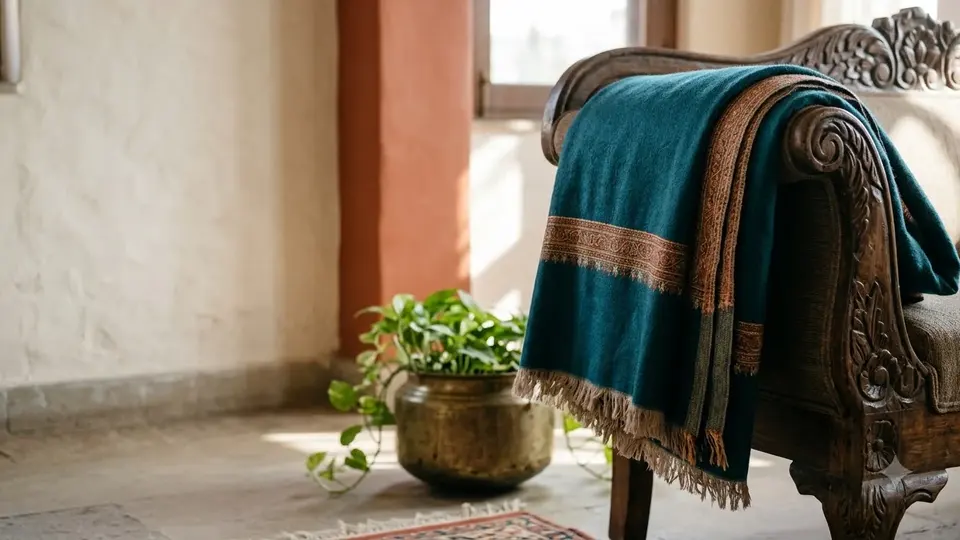
Pure Kashmir, in its pashmina care guide, treats pashmina more strictly than ordinary wool, and the four shawls here carry fibre lines and care lines that differ from seller to seller. A woollen shawl for women in winter is compared first on those two details, then on size.
Kullu Kinori shawl: fibre, size and care
The fibre is named as pure wool, the size is in centimetres, and the handloom and handmade statements sit alongside a clear care method. The seller calls it pure wool, handloom and handmade, with a cold water wash and no detergent powder.
No seller name appears on the page, and no weight is given. A third dimension of 0.25 appears without a unit, so that figure is left aside.
Handloom and handmade are the seller’s own words, and they come with no independent check. A cold water wash without detergent powder is the care the seller gives. Of the four shawls it alone can be washed at home on the seller’s own advice, since two others say dry clean only.
Fabindia shawl on a retailer entry
The shawl is a long rectangle, 220 x 100 cm as length by width. It is longer than the Kullu shawl and shares its width.
Fibre is given as wool with no percentage, and the care is dry clean only. A buyer who wants a long wool shawl from a known Indian brand, bought through a retailer, finds it here.
This entry comes from Nykaa Fashion, not Fabindia’s own site, and the description text on it belongs to a cotton children’s set. Only the specification fields are used, so no weight or handloom statement is available.
Exotic India pashmina: no size or care line
The plain handloom pure pashmina shawl is sold by Exotic India, and the title and keywords carry the pashmina and handloom statements. The seller is an established Indian craft seller.
No size, weight or care line appears in the visible text. Pashmina is also not described as wool in the body of the entry, so the fibre statement rests on the title and keywords.
Pashmina has the strictest care of the four fibres named here, and the entry gives no care line. Its size and weight are not stated either.
IndiaHandmade winter shawl: pure wool and cotton
The IndiaHandmade winter shawl contradicts itself on fibre. Its salient features say pure wool, and the table lower on the same page lists cotton.
Both statements cannot describe the same cloth, and only the seller can say which one applies. The conflict is left as the page presents it.
Otherwise it is a large piece. The seller, named as Bashir Ahmad Dar, gives 72 x 90 inches and describes it for winter wear or formal use, and says dry cleaning keeps the wool soft and its structure intact.
Fibre, size and care lines compared
Kullu says pure wool, Fabindia says wool with no percentage, and the IndiaHandmade shawl lists both pure wool and cotton. Sizes are in centimetres for Kullu and Fabindia and in inches for IndiaHandmade, while Exotic India gives none.
Two sellers say dry clean only and Kullu gives a cold water wash. No seller states a weight.
Pure wool, pashmina and blend labels
Fibre is where the four shawls differ most. Kullu says pure wool, Fabindia says wool without a percentage, and the Exotic India title says pure pashmina handloom.
Wool blend is the third label, and none of the four uses it by name. The nearest case is the IndiaHandmade winter shawl, where the pure wool claim and the cotton line sit side by side.
For pashmina, care guidance is stricter than for ordinary wool. Pure Kashmir allows only cold water and a mild wool safe soap, with no hot water and no standard detergent. It rules out a washing machine, even on a wool or delicate cycle, because of the risk of permanent shrinkage.
Handloom or machine made
Kullu’s seller states handloom, and the IndiaHandmade seller says its shawl is made on handlooms. The Exotic India title also carries the word.
The IndiaHandmade seller adds that machine made woollen shawls are often processed at high speed, which reduces fibre strength and softness. That is the seller’s own claim and not an independent test.
Fabindia makes no handloom statement, so how that shawl is made is not known.
Everyday wear or occasion wear
Size is the first practical difference between a shawl for daily cold and one for a wedding or family function. The handloom shawl is the largest, and its seller describes it for formal use as well as winter.
Care is the second difference, and it matters for occasion wear as much as size does. Two of the four sellers say dry clean only: each outing is followed by a trip to a dry cleaner.
The Kullu seller gives a cold water wash, a method presented for the shawl itself and not for a dry cleaner.
Uses by shawl
Traditional handloom wool, washed by hand in cold water, is what the Kullu shawl provides.
Fabindia’s shawl is for a buyer who wants a long wool shawl from a known Indian brand and accepts dry cleaning as the care method.
The IndiaHandmade shawl is a large handloom piece for winter wear or formal use, once the seller has settled the pure wool and cotton question. Exotic India’s pashmina is for a buyer who wants pashmina from a craft seller and is ready to ask for the missing size and care details.
Size across the four
Units alone split the group. The Kullu and Fabindia shawls are sized in centimetres, the IndiaHandmade handloom shawl in inches, and the Exotic India shawl not at all.
Fabindia is the longer of the two metric shawls, and both share the same width. The handloom shawl is the largest of the four.
Only three of the four sellers give a size at all, so the Exotic India shawl cannot be placed on this scale.
Who sells what
Two of the four shawls sit on the IndiaHandmade marketplace, so they share one site’s way of presenting products. Exotic India is a craft seller with its own site, and Fabindia’s shawl is read from a Nykaa Fashion entry. The Kullu listing sits on the same IndiaHandmade marketplace as the winter handloom shawl and does not name its seller.
Every product fact comes from what a seller wrote about its own goods, and no independent test of fibre content, strength or softness stands behind any of the four. Pure Kashmir and Woollen Wear are the two care sources outside the sellers, and both write about wool and pashmina in general and not about these four shawls.
Reading size and care
Size and care are the fields that carry real differences here. A length and a width in centimetres can be compared directly, and a size in inches can be converted. Trouble starts when no unit is given, as on the Kullu third figure, or no size at all, as on the Exotic India entry.
Weight is the field none of the four fills in. For a shawl worn through a winter evening, it would show how heavy the shawl feels on the shoulders.
Dry clean only, cold water without detergent powder, and a mild wool safe soap for pashmina are three separate instructions, and a buyer has to follow whichever one the seller gives.
Fibre and care also have to agree with each other. A pure wool statement beside a cotton line, as at IndiaHandmade, leaves a buyer with no sure way to know which care method suits the cloth that arrives.
The fibre conflict and care
Care depends on the cloth, and Pure Kashmir treats pashmina more strictly than ordinary wool. A shawl described as pure wool and cotton at once leaves a buyer unable to tell which rules apply.
The IndiaHandmade seller says dry cleaning keeps the wool soft and its structure intact. That advice holds only if the cloth is the wool the seller describes, which is the point the seller leaves unsettled.
What the four listings leave unstated
Several gaps remain across the four pages.
- Weight of the shawl, which none of the four states.
- Unit of the third Kullu dimension.
- Fibre of the IndiaHandmade shawl, wool or wool and cotton.
- The size and care method of the Exotic India pashmina.
- Whether the Fabindia shawl is handloom or machine made.
Washing and drying a wool shawl
Two sellers say dry clean only, one gives a cold water wash without detergent powder, and the fourth shows no care line at all.
Pure Kashmir calls dry cleaning the most cautious route for embroidered pashmina such as Jamawar, Sozni and Tilla pieces. The Exotic India shawl is sold as plain, so that advice concerns a different kind of piece.
For a wool piece that has been washed, Woollen Wear says to press out extra water instead of wringing, and then to lay the piece flat on a towel to dry. The Kullu seller and the two dry clean only sellers say nothing about drying.