Warmth figures mean different things on these four jackets. Decathlon prints a temperature in the product name, Quechua gives two different ones for the MH500, and Uniqlo labels its figure as an estimate drawn from third party simulations. Fill, shell and care are easier to compare across a winter jacket for women than the temperature in its name.
Forclaz MT900: hood, down and warranty
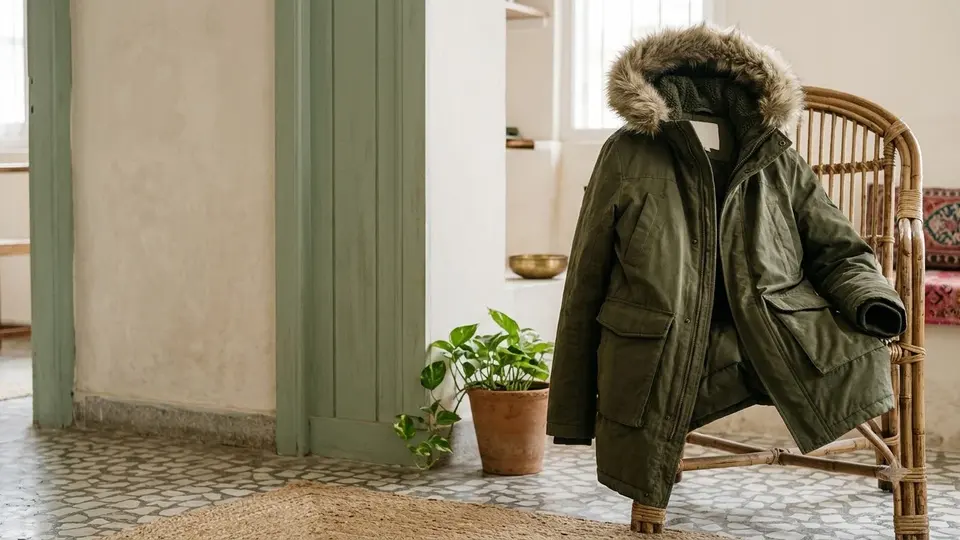
A hood, a down fill and the lowest temperature figure sit together on this jacket, and none of the other three has all of them. It comes in maroon.
Decathlon calls it lightweight and packable, which suits a jacket that travels in a bag to the hills. The text gives no weight to check that against.
The product name says up to -20 C. That is Decathlon’s own figure, and no fill weight stands behind it.
Decathlon adds a warranty of 2 years, a return window of 30 days, and exchange and replacement. Those are the widest after purchase terms of the three Decathlon jackets.
The gaps are the usual Decathlon ones. Shell and lining material, water resistance, pockets and weight are all missing, and the product text names SIMOND as well as Forclaz without saying how the two relate.
Uniqlo down short coat: fill power and care
The coat is the one to read for what is inside the jacket. The filling is 90 percent down with feathers making up the rest, and the fill power is 750+.
Polyamide is the shell, the cut is relaxed and the colour is black. Uniqlo says the finish repels light rain and gives no waterproof rating.
Its own warmth figure is a recommended minimum of about -20 C, labelled as an estimate drawn from third party simulations. Uniqlo therefore names its method, which Decathlon does not do for the figures in its product names.
No hood is mentioned, and there is no down weight. Care is a cold hand wash, with no dry cleaning and no tumble drying.
Online orders cannot be exchanged for another size or colour. Returns go by post to the warehouse, and the customer pays the shipping unless Uniqlo made the error.
Uniqlo’s women’s coats range also shows double face, faux shearling, trench, Chesterfield, hooded long and duffle styles. None of them states fill or hood details, so they cannot be compared with this coat on warmth.
Forclaz MT100 in five colours
The MT100 is a hooded puffer for mountain or cold city wear, sold in five colours with sizes from XS to 2XL. Its name carries -5 C, the mildest figure of the three Decathlon jackets.
Decathlon says it helps the wearer stay protected from winter, which is a brand claim. Fill type, shell, lining, water resistance, pockets and care are all unstated, so the temperature in the name is the only warmth detail.
The warranty and the return window match the MT900. Only the exchange and replacement terms are missing.
Quechua MH500 and its two temperatures
The name says -10 C, while the description says it keeps the wearer warm as low as -6 C, and the product text gives no way to settle which is meant.
Beige and hooded, the MH500 is called a hiking and trekking puffer in one place and a warm padded jacket in another. Quechua describes it as slim, lightweight and compact, again in the brand’s own words.
Fill, shell, water resistance, pockets and care are not stated. Decathlon lists the same warranty as on the other two jackets and an exchange period of 30 days.
Hood, fill and terms after purchase
All three Decathlon jackets have a hood, while Uniqlo is the only maker that prints a down share and a fill power. Quechua gives both -10 C and -6 C for the MH500, so each temperature is the brand’s own word.
The Decathlon jackets share a 2 year warranty, Uniqlo does not exchange online orders for another size or colour, and care is stated only by Uniqlo.
Padded and down in the Indiahikes advice
Indiahikes, writing about layering for Himalayan winter treks, favours padded jackets for most trekkers. The advice is aimed at hill routes, which matters for anyone taking a jacket to the mountains.
The same guide says down with a higher fill power keeps the wearer extra warm. Uniqlo is the only maker here that prints a fill power, so it is the only place where that statement can be matched to a number.
Naming follows the same split. The MT100 is called a puffer, the MH500 a puffer and a padded jacket, the MT900 a down jacket, and the Uniqlo item a down short coat. On the Indiahikes reading, the first two lean to the padded side and the last two to the down side.
A fill share and a fill power describe the material inside a coat, so they can be set beside the same figures on another down coat. A temperature describes what the brand expects of the jacket, and it has to be taken as the brand’s word.
Uniqlo labels its temperature as an estimate and names simulation as the source. A Decathlon product name has no room for a method, and the MH500 shows that a name and a description from one brand can disagree.
Two jackets can print the same temperature and still differ in what is inside them, so a figure on its own does not rank one above the other.
MT900 against the Uniqlo coat
Each leads the group for a different reason. The MT900 has the hood and the colder printed figure, and Decathlon backs it with the widest set of return terms. Uniqlo’s coat has the stated fill, the stated shell and a care method.
A buyer heading to the hills sees the hood first, and a buyer who wears one coat to work every winter morning sees the fill power first. Neither jacket states water resistance beyond a light rain finish on the Uniqlo coat.
Take two jackets described in general terms, one that states a down share and a fill power and one that states only a temperature. The first lets a buyer compare its material with other down coats. The second leaves only the question of whether the brand’s figure suits the trip.
Rain
Light rain is the most any of the four claims to handle. Indiahikes says its own jackets may withstand rain for a few minutes but will not last in heavy rain, and it gives no rain rating.
None of the four makers gives one either.
A commute or a hill trip
On a weekday commute, care and fit are the details that apply every day. Only Uniqlo names a fit and gives a care method, while the MT100 and MH500 state no care at all.
For a hill trip, the hood and the temperature figure count most. All three Decathlon jackets are hooded and each prints a temperature, whereas Uniqlo gives an estimate and says nothing about a hood.
Using one jacket for both means accepting a gap. A Decathlon jacket leaves the fill figure out, and the Uniqlo coat leaves out the hood and has to be washed by hand.
For a gift, colour and size are the details stated: maroon for the MT900, five colours for the MT100, beige for the MH500 and black for the Uniqlo coat. The Uniqlo exchange rule matters most when the size is a guess.
Warranty, returns and exchange
The three Decathlon jackets share a 2 year warranty, and the returns differ in small ways. The MT900 and MT100 carry a return window, the MT900 adds exchange and replacement, and the MH500 lists an exchange period instead.
Uniqlo works differently. Its online terms are stricter, with no exchange for size or colour and a posted return that the customer ships.
Decathlon owns the Forclaz and Quechua names, so the jackets are sold under its own sub brands. Uniqlo sells the coat under its own name.
The four jackets detail by detail
Hoods split the group: the three Decathlon jackets have one, and Uniqlo does not mention one.
Shell material is stated by Uniqlo alone, as polyamide. The MT900, MT100 and MH500 give no shell or lining, and none says anything about pockets.
Water resistance follows the same split: Uniqlo describes a finish for light rain, and Decathlon states none.
Weight is missing from the MT900 text, which only calls the jacket lightweight and packable, and Uniqlo gives no down weight either.
Care appears for the Uniqlo coat only. A buyer who wants to know how a Decathlon jacket should be washed would have to ask the seller or read the care label on the garment.
Details missing from the Decathlon text
The Uniqlo coat carries more checkable facts than the three hooded jackets together, as the Decathlon text leaves out the following:
- Fill type for the MT100 and MH500, and fill weight for all three.
- Shell and lining material for all three.
- Water resistance and pockets for all three.
- Care for the MT100 and MH500, and weight for the MT900, which Decathlon calls lightweight.
Uniqlo covers fill, shell, fit, finish, a temperature estimate and care. It leaves out the hood, the down weight and a waterproof rating.