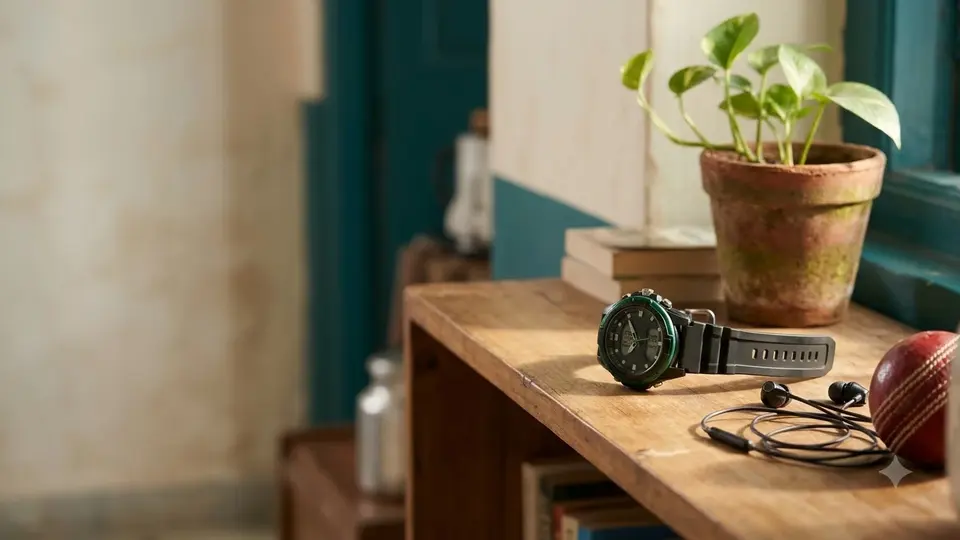
Casio digital quartz models on resin straps and the occasional Seiko automatic on metal are the watches found for nurses in India. Across these four the cases run from a compact digital to one that measures 50.5 x 50.4 mm, and the best watch for a ward is judged more by case depth, strap material and timing functions than by water rating.
Three of the four are digital Casio quartz models, and the fourth is a Seiko 5 Sports automatic with an analog dial and a metal strap.
Casio W-221H-1AV: case, timer and warranty
Size and function decide it. The W-221H-1AV has a 38.4 mm dial and is 12.2 mm thick, the smallest case among the four, and a retailer on justintime.in names a stopwatch, an alarm and a timer along with an LED backlight.
A narrow case sits under a cuff more easily, and a resin strap with a pin buckle is light and can be rinsed along with the wrist during a wash.
Water resistance is 5 ATM, above the handwashing minimum, and the maker gives a 24 month warranty.
The 10 year battery claim appears only in the retailer description, and nothing says how the backlight is switched on, which matters to a nurse who needs light quickly.
Casio DW-291H-1BVDF and its timing features
There are five daily alarms, a stopwatch that reads to 1/100 second and an amber LED backlight, which helps in a dim ward.
The case has mineral glass and a resin band, and the battery is a CR2025 rated for around 10 years, with a 2 year warranty.
Water resistance is given as 200 m, far above what handwashing needs. No Casio page confirms that figure, and the retailer on watchtopia.in names no seller.
It is also the largest case of the four, at 50.5 x 50.4 x 13.5 mm. A watch more than 13 mm deep can catch on a sleeve or glove, so the model suits a nurse with a larger wrist who values the timer above compact size.
Casio W-218H-3BV: battery and what the listing omits
The long battery is the draw. Around 7 years on a CR2016 cell means one fewer thing to arrange around a rota, and the warranty is 2 years.
A watchtopia.in retailer lists a 44.4 x 43.2 mm case with resin glass and a resin band, and a water rating of 50 m; that band is washable and light.
The retailer is not Casio and does not say whether this model has a stopwatch or a backlight, so its use for counting pulse cannot be confirmed.
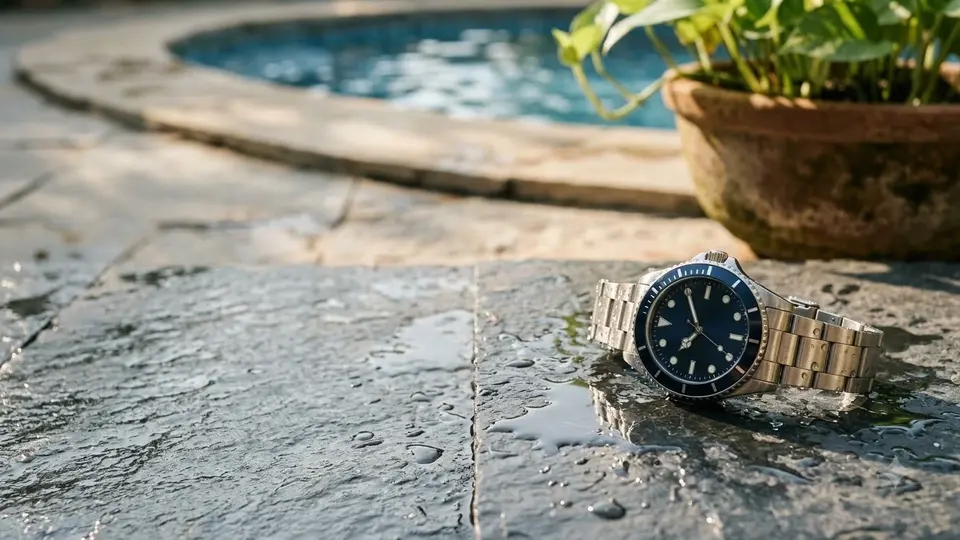
A 42.5 mm case with Hardlex glass is listed by Seiko India, and the movement is the Calibre 4R36, an automatic with manual winding and a stated duration of around 41 hours.
Water resistance is 10 bar, which clears the handwashing minimum with room to spare. The metal strap is heavier than resin and takes more time to dry after a wash.
Seiko’s text does not say whether the seconds hand sweeps or how legible the dial is in low light, and it lists no warranty term. At 13.4 mm thick the case is bulky, and the automatic movement needs regular wear to keep time.
The listing describes no timing function, so the watch suits a nurse who wants a conventional dial more than one who needs a timer.
Water rating for handwashing on a ward
Sylvi says a 3 ATM watch can be hand washed if the wash is kept under about half a minute and the soap stays off the crown. The crown is the small knob on the side of the case, and it is the usual weak point where water gets in.
A short rinse of the wrist and strap, with the case held clear of the lather, fits that advice.
Watch boxes carry figures in ATM, bar and metres, and all of them describe one pressure value. time4diamonds says 10 bar and 100 m are the same rating, and the metre figure comes from a still tank pressure test, not from a depth the wearer should try to reach.
Moving water changes the picture: Sylvi points out that the pressure from slow swimming strokes can go above the rating, so a watch at that level is not a swimming watch.
On a ward the exposure is a tap and a basin. A higher case rating gives a margin that the work does not demand, so water resistance does not separate the four picks. Strap material, case size and the timing function do.
The listed ratings are 5 ATM on the W-221H-1AV, 50 m on the W-218H-3BV, 200 m on the DW-291H-1BVDF and 10 bar on the Seiko, and each is above the handwashing minimum. Seiko writes its figure in bar, while the Casio listings use ATM and metres.
Only two of the four have timing features that are confirmed. The W-221H-1AV lists a stopwatch, an alarm and a timer, and the DW-291H-1BVDF adds multiple daily alarms and a finer stopwatch.
For the W-218H-3BV the retailer text is silent on both the stopwatch and the backlight. The Seiko is analog with no timing function described.
A backlight matters in a dim ward, and two of the four confirm one. How the light is switched on matters for reading a dial quickly, and the W-221H-1AV text does not describe it.
Digital stopwatch vs analog dial
Pulse counting means watching seconds for a set period. A digital watch with a stopwatch does this directly, and a backlight helps in a dim ward.
An analog dial shows the time at a glance, and some analog models carry a moving seconds hand that can also be used for counting. A plain analog watch leaves the wearer to read that hand. Timex explains that on a chronograph the extra pushers start, stop and reset the timing hands, a function a nurse might use for a pulse count.
For that reason the digital stopwatch is the main choice here, and the analog Seiko is included for nurses who prefer a dial. Casio and Seiko do not describe any of the four as a clinical or medical device.
Quartz and automatic movements on a ward
A ward watch gets worn for hours, taken off, and put on again many times, so the effort it asks for between shifts counts as much as its features.
Two Broke Watch Snobs rates quartz watches as needing less upkeep than mechanical ones, which suits a watch that is worn every shift and removed at the end of it. All three Casio picks are digital quartz watches, and each has a battery life stated by its retailer.
An automatic is wound by wrist movement. Seiko lists a duration of around 41 hours and manual winding as well, so a watch left in a locker for a few days needs winding or wear before it keeps time again.
Case depth and strap on a long shift
A watch worn for a full shift is felt more than it is looked at. Case depth decides whether it catches on a cuff or a glove, and the strap decides whether it can be rinsed along with the wrist.
Three of the four picks use a resin band, and the Seiko uses metal. The resin watches are also the thinner ones, from the slim W-221H-1AV to the deeper DW-291H-1BVDF.
A watch that runs for years on one cell asks nothing of the wearer on a busy rota, and the three Casio models state their battery lives in years. The Seiko has no battery and asks for wear or winding instead.
Thickness is stated for every pick, so it can be set against the cuff of a uniform. The two larger Casio cases, the W-218H-3BV and the DW-291H-1BVDF, are both deeper than the W-221H-1AV, and a slim wrist under a snug sleeve shows that difference first.
Resin bands have holes that set how tight they sit, while a metal bracelet is set by the number of links it carries.
Glass differs as well. The DW-291H-1BVDF has mineral glass, the W-218H-3BV has resin glass, the Seiko has Hardlex glass, and the W-221H-1AV is listed with a resin strap on a pin buckle. All four listings name the strap material, so that detail can be compared directly.
Battery and warranty terms of the four
Each Casio lists its battery in years. The W-221H-1AV carries a 10 year claim in the retailer description, the DW-291H-1BVDF uses a CR2025 cell rated for around 10 years, and the W-218H-3BV uses a CR2016 cell rated for around 7 years.
Warranty terms follow a similar split: the W-221H-1AV has 24 months from the maker, the other two Casio models have 2 years each, and Seiko lists no term for the SRPD61K1.
The case sizes shown on the listings are 38.4 mm for the W-221H-1AV, 44.4 x 43.2 mm for the W-218H-3BV, 42.5 mm for the Seiko and 50.5 x 50.4 mm for the DW-291H-1BVDF. Thickness runs from 12.2 mm on the smallest Casio to 13.5 mm on the largest.