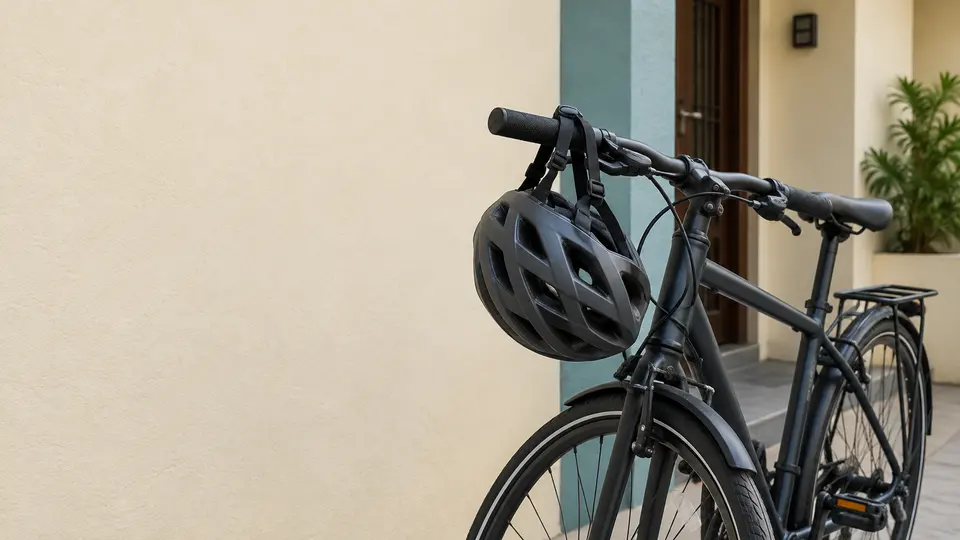
best cycling helmet for daily commute: The MET Lupo is the pick for a daily commute, with the most vents of the four, an adjustable visor and head sizes stated by circumference. The Bell Formula is the light road helmet, the KED Rayzon is the only one with a built in LED for rides after dark, and the Rudy Project STRYM ranks last.
Method: specifications and warranty are read from brand pages and Amazon listings, last checked 10 Nov 2026. Nothing here is lab-tested. How we pick. Site facts.
On this page (9 sections)Picks at a glance
Our pickMET MTB Cycling Helmet LupoA rider who wants a visor and high ventilation on a helmet with clear head circumference sizing.
These helmets are for riders on paved commuting routes, and the head size band is the detail worth reading before any other, since the standard marking does not separate them. MET and Rudy Project give a clear head measurement, while Bell and KED leave it to the seller, and weight, vents and extras decide the rest of the best cycling helmet for a daily commute.
MET Lupo: sizing, vents and visor
Sizing is the clearest of the four. MET gives a head circumference band for each of S, M and L, and the bands share their edge values, so every head in the range has a listed size.
Ventilation is the highest, at 20 openings. An adjustable micrometric visor can be angled for a route that faces the sun, and reflectors are listed, though no light is offered.
At 270 g the Lupo is heavier than the Bell and lighter than the KED.
MET describes it as an MTB helmet, yet it names the same bicycle standard, EN 1078, as the two road models. No warranty is stated for it.
Bell Formula at 255 g
The Formula is the lighter road option, with 19 vents. Its marking reads “CE EN1078 CPSC Bicycle”, which gives it a European and a United States reference.
Sizes run S, M and L on the Formula, but the size guide is an image with no readable range. Bell also gives a single weight and does not say which size it describes.
A visor, reflector, light and warranty are not mentioned in the published details. What the Formula offers on paper is a low weight, many vents and a double standard reference, which are the details that matter most to a rider on a paved route in daylight.
Integrated LED on the Rayzon
KED builds a light into the Rayzon. Its K FIT system has an integrated LED that works as a reflector and as a flashing light, so a rider who leaves early or returns after sunset has a light on the helmet itself.
Weight is the cost. The Rayzon weighs 320 g in M and 330 g in L, the heaviest of the four, and compared with the Bell that is more than 60 g extra to carry on every ride.
KED lists 18 vents and EN 1078, and it sells the Rayzon as a road and MTB helmet. Its size bands are given as centimetre ranges without a statement that they refer to head circumference, and no visor or warranty is stated.
STRYM from Rudy Project: light, with a gap in sizes
Rudy Project’s STRYM is the lightest of the four, at 250 g in S/M. It is also the only one to name a second standard by number, CPSC 12.03, next to CE / EN 1078.
Against that, it has the fewest vents, 16, and no visor, reflector, light or warranty is stated.
Its two size bands leave a gap between them, and Rudy Project does not say where a head that falls in that gap belongs. Two stated weights, one for each size, show what the larger size adds. The STRYM is the one to look at for a rider who puts weight above everything else and is content with fewer vents.
SuitsA rider who wants a lighter helmet with a stated head size band for each size.
Keep in mindVisor, light options and warranty are not stated.
Search on Amazon India Opens an Amazon India search for this model. Price and offers are shown there.
As an Amazon Associate I earn from qualifying purchases. Read the disclosure.
Weight, vents and extras of the four commuter helmets, with our pick first
Helmet
Weight
Vents
Visor or light
MET Lupo (our pick)
270 g
20
Adjustable visor
Bell Formula
255 g
19
Not stated
KED Rayzon
320 g (M), 330 g (L)
18
Built in LED
Rudy Project STRYM
250 g (S/M), 270 g (L)
16
Not stated
Model Benchmark
4 verified models compared
4 verified models compared
4 verified models compared
EN 1078 on all four
Every one of the four helmets names EN 1078, and none is a motorcycle helmet. Bell and Rudy Project add a CPSC reference, while KED and MET name EN 1078 alone.
The names are reported as the retailer prints them, and the exact test requirements are in the standard itself. Because all four carry the same EN 1078 name, the marking does not separate one helmet from another.
MET’s Lupo is the one that can look out of place, since it is an MTB model sold next to road helmets. Its standard name is the same one the road models carry, and the difference lies in the category label and not in the marking.
Weight and vents
The lightest helmet has the fewest vents, and the helmet with the most vents sits in the middle on weight. The Bell lies between those two on both counts.
From lightest to heaviest the order runs Rudy Project, Bell, MET and KED. The first three sit close together on the scale, and the KED stands apart from them.
Vent counts follow a different order, from MET through Bell and KED down to Rudy Project. The spread between the most and the fewest is four vents, a narrower gap than the one in weight.
Weight also changes with size for Rudy Project, by 20 g, and for KED, by 10 g. Bell and MET give one figure each and do not say which size it covers. A rider who wants to know what the larger size adds can see it for the Rudy Project and the KED, while for the Bell and the MET the weight is not given by size.
Lights, visors and the route
Two of the four helmets carry equipment beyond the shell and the vents. KED has the integrated LED, and MET has the visor that angles up or down.
On a commute that starts before sunrise or ends after sunset, the KED is the only helmet of the four with a light on it. MET lists reflectors, and Bell and Rudy Project mention neither reflectors nor lights.
A short daylight ride makes the extra equipment count for less, and head size and fit carry more of the decision than weight or vent count. Over a long daily stretch the order changes. A hypothetical commute of around 15 km each way puts weight and ventilation first, and on paper the Bell, the Rudy Project and the MET have the most to offer there.
The KED trades that advantage for its light, and the MET offers the visor and the highest vent count at a middling weight. None of the four supplies both a light and a visor.
Road and off road labels
Cycling Boutique sorts the four helmets into different categories. Bell sells the Formula as a road helmet, KED lists the Rayzon as a road and MTB helmet, and MET lists the Lupo as an MTB helmet. The STRYM is placed in neither group.
A commuter on paved city roads is therefore looking at one road model, one dual purpose model and one off road model, with a standard marking of the same kind on each. All four sets of details come from that one retailer.
Head size bands
MET’s three bands start at 52 cm and share their edge values. Rudy Project uses two bands, S/M from 55 to 58 cm and L from 59 to 61 cm.
Head size information varies the most between the four. MET and Rudy Project give a clear measurement statement, while Bell and KED leave the rider to look for size details elsewhere. Bell and MET offer three sizes, S, M and L, while Rudy Project folds the small and medium into one S/M size. A rider between two sizes has the most room to choose with MET, where the three bands are set out side by side.
Frequently asked questions
What does EN 1078 mean on a cycling helmet?
EN 1078 is the European bicycle helmet standard that all four helmets here name, as the retailer prints it. A rider who wants the exact test requirements has to read the standard itself.
How are cycling helmets sized?
Cycling helmets are sized by head circumference, and a tape measure around the head gives the figure to hold against a brand's bands. MET and Rudy Project print those bands, while Bell shows its size guide only as an image.
Do cycling helmets come with a built in light?
Few do. Among the four helmets in this guide, only one has an integrated LED, which works as both a reflector and a flashing light.
Does a commuter cycling helmet need a visor?
A visor is of most use on a route that runs toward the sun for long stretches, and it matters less on a short daylight ride. Only one of the four helmets here has an adjustable visor.
FitnessTop picksBest gym gloves in India for lifting and wrist supportThe Boldfit Lifting Grip Bold is the pick, the only glove here with a padded leather palm and thumb loops that carry a neoprene wrap. The Nivia Scorpion is the one with stated sizes from S to XL, and the Lifelong half finger glove ranks last.4 products compared · 6 min read→FitnessBuying decisionBest foam roller in India for beginners at homeThe Decathlon 100 Soft is the pick, the only one of the four stated to be soft, which is where Cleveland Clinic and Harvard Health both start beginners. The Decathlon 500 Hard is the firm, textured step for later, none of the four gives a density figure, and the R.N.V. Sports MR 28 ranks last.4 products compared · 4 min read→FitnessBuying decisionBest resistance bands in India: tube, loop or hip bandThe Boldfit Resistance Tube Set of 11 is the pick, a natural latex kit with handles and a door anchor for full body work at home. A long loop suits pull up assistance, a fabric loop suits glute work, each brand states its own kg figures, and the Nivia pack ranks last.5 products compared · 4 min read→FitnessBuying decisionBest yoga mat for beginners in India: TPE, PVC or rubberThe Boldfit Pro Grip TPE mat is the pick, a 6 mm mat that Boldfit states outright as TPE. The Cult TPE is the latex free alternative with a strap, and the Kobo PVC mat is placed last because its details come from a retailer listing and not from Kobo.5 products compared · 5 min read→FitnessBuying decisionBest Bicycle Lock for Daily Commute in IndiaThe Kryptonite KryptoLok Combo is the pick for an all day rack, the one lock named with the Gold grade that BikeRadar links with long stays. The Abus Facilo is the other U lock, while a chain or a cable fits short stops and the light Abus cable lock ranks last.6 products compared · 4 min read→FitnessTop picksBest cricket bat for kids under 10 in India, by ball and sizeThe Decathlon T500 Lite in size 4 is the pick for tennis ball play, and the Kashmir willow KW150 is the bat listed for leather ball cricket. Size follows height, and the bats checked rarely give any age or weight. The SG HP Blitz ranks last, as it is aimed at older children.6 products compared · 5 min read→