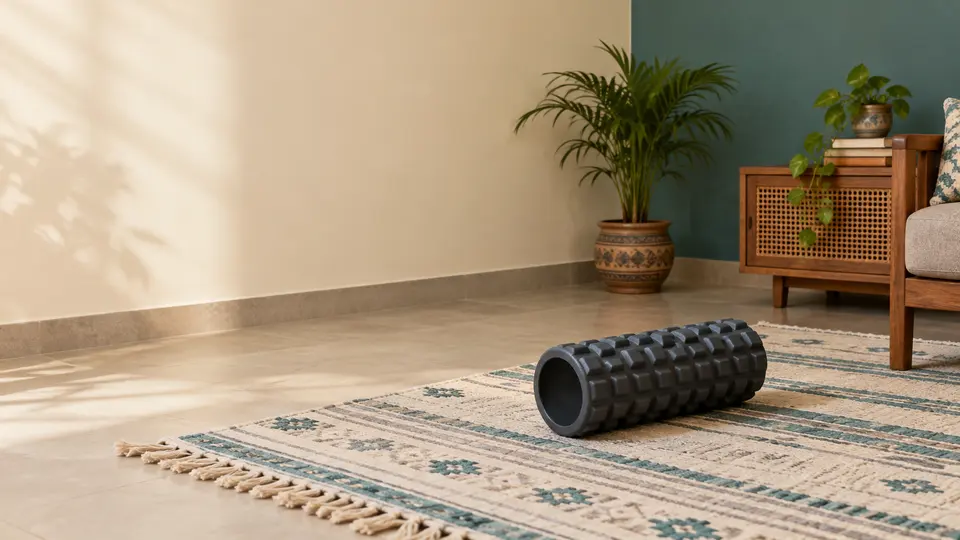
best foam roller: The Decathlon 100 Soft is the pick, the only one of the four stated to be soft, which is where Cleveland Clinic and Harvard Health both start beginners. The Decathlon 500 Hard is the firm, textured step for later, none of the four gives a density figure, and the R.N.V. Sports MR 28 ranks last.
Method: specifications and warranty are read from brand pages and Amazon listings, last checked 6 Nov 2026. Nothing here is lab-tested. How we pick. Site facts.
Foam rollers on Indian listings give firmness as a single word, Soft, Hard or High Density, with no density figure, and only two of the four listings here state a size. The best foam roller for a first purchase, as Cleveland Clinic and Harvard Health describe it, is a soft, smooth one, and among these four only the Decathlon 100 Soft is named as soft.
Decathlon 100 Soft: the soft start
Both health sources start beginners at the soft end. Cleveland Clinic says softer rollers are often recommended for beginners, while frequent exercisers and avid runners tend to prefer firmer foam.
Harvard Health tells beginners to begin with a soft, smooth roller, since bumps deliver deeper pressure. For someone who has just started running and wants to roll the quads, the 100 Soft matches that first step.
Decathlon gives the 100 Soft’s hardness in the product name and states no density figure. It describes the roller as giving muscles and trigger points a deep massage.
No material, dimensions or weight are stated, and the item is listed as non returnable. A buyer who is unsure about firmness cannot send it back, as per Decathlon.
The 500 Hard and its textured grip
Decathlon calls the 500 Hard hard, gives it a textured grip and describes it for deep muscle relaxation. It is the later step for a roller user who has outgrown the soft one.
Cleveland Clinic links firmer foam to frequent exercisers, and says textured surfaces can help with deep knots. The 500 Hard is both firm and textured, so it matches that description.
Beyond the word Hard, Decathlon gives no density figure, and it states no material, dimensions or weight.
LLFR03: compact EVA and PVC
Lifelong makes the compact option, and the LLFR03 is EVA foam and PVC, with its size given in the sizes section below.
High density is the only firmness word Lifelong gives, and it says nothing more on that point. The roller cannot be placed on a firmness scale next to the Decathlon pair.
Weight and surface details are missing, and the replacement terms are covered under warranty and returns below.
R.N.V. Sports MR 28 and its grid
The MR 28 is a grid roller in EVA foam, sold in Coal Black and described for all parts of the body. Going by Harvard Health’s description of bumps, a grid would deliver deeper pressure, though the retailer does not describe the grid.
Kibi Sports, a retailer, supplies the details, and the maker does not. They give no density, weight, warranty or returns policy.
A roller sold for all parts of the body sits against the advice on joints and bony areas given further down.
SuitsA reader who specifically wants a grid pattern roller.
Keep in mindThe details come from a retailer, Kibi Sports, and not the brand, and give no density, weight or description of the grid.
Search on Amazon India Opens an Amazon India search for this model. Price and offers are shown there.
As an Amazon Associate I earn from qualifying purchases. Read the disclosure.
Foam rollers compared on firmness, material and size, with our pick first
Roller
Firmness
Material
Size
Decathlon 100 Soft (our pick)
Soft
Not stated
Not stated
Decathlon 500 Hard
Hard, textured grip
Not stated
Not stated
Lifelong LLFR03
High density
EVA foam and PVC
14 x 14 x 33 cm
R.N.V. Sports MR 28
Grid pattern
EVA foam
12 inches
Model Benchmark
4 verified models compared
4 verified models compared
4 verified models compared
The technique and common areas
Cleveland Clinic describes foam rolling as a self myofascial release technique that uses a dense foam tube. Common areas are the upper back, the quads and the calves.
Soft, hard and high density
With no density figure on any of the four, the words Soft, Hard and High Density cannot be placed on a single scale. Only the Decathlon pair can be ordered against each other, since one is named soft and the other hard.
Lifelong’s high density label gives no sign of where the roller falls between them, and the grid on the R.N.V. Sports roller may be firmer or softer than a smooth roller; the retailer does not say.
Time per muscle group
Cleveland Clinic suggests slow passes over sore or stiff areas, for about 1 to 2 minutes per muscle group. Harvard Health suggests 30 to 60 seconds on each muscle group, repeated three to five times.
Each range is the source’s own, and the two do not match. Neither ties the time to a type of roller, and time guidance is absent for the four rollers themselves.
Areas to keep the roller off
Cleveland Clinic calls foam rolling generally safe, and says not to roll directly over joints such as the ankles, knees or elbows. Harvard Health lists bony areas such as the knees, pelvis and shoulder blades, and says to keep the roller on soft, fleshy tissue.
A person with a broken bone or a torn muscle, or who is pregnant, should talk to a doctor first, Cleveland Clinic says. Harvard Health adds that a roller is not a substitute for medical advice.
Cleveland Clinic also says there is no real evidence that foam rolling improves the appearance of cellulite.
Quads and upper back
Harvard Health puts the shoulder blades among the bony areas to keep the roller off, although the upper back is one of the areas Cleveland Clinic names as common.
Details for the four rollers say little about body areas. The 100 Soft is described for muscles and trigger points, and the R.N.V. Sports roller is described for all parts of the body.
Lifelong and the 500 Hard name no body area, so a roller for the quads comes down to firmness and size.
Warranty and returns
Decathlon gives a 2 year warranty on both of its rollers, and the 100 Soft is the one listed as non returnable.
Lifelong lists no warranty and offers a 7 day replacement for damaged, defective or incorrect items, while the R.N.V. Sports retailer states neither a warranty nor a returns policy.
The Decathlon and Lifelong details come from the sellers or brands themselves, while the R.N.V. Sports details come from the retailer.
Sizes on offer
Stated sizes come only from Lifelong and R.N.V. Sports: the Lifelong figure covers three dimensions, 14 x 14 x 33 cm, while the R.N.V. Sports figure is a single measurement of 12 inches.
Converted, that is a little shorter than the Lifelong length. Decathlon states no size for either of its rollers, so a reader with a short shelf or a small bag has lengths for only two of the four.
Frequently asked questions
How often should you foam roll?
Daily rolling or a few sessions a week are both described by Cleveland Clinic, with a whole session kept under about 10 minutes. Harvard Health puts the minimum at twice a week.
Does foam rolling help with muscle soreness?
Foam rolling has not been proven to help with delayed onset muscle soreness, known as DOMS, according to Cleveland Clinic, so it should not be expected to prevent soreness after a workout.
Does foam rolling improve flexibility?
Harvard Health says some evidence suggests benefits for range of motion and movement efficiency, though it cites no specific studies, so the evidence on flexibility is limited.
Is a soft or hard foam roller better for beginners?
A soft, smooth roller is the usual start for beginners, as per both Cleveland Clinic and Harvard Health. Harvard Health gives the point for moving to firmer foam as once the tissue has loosened.
FitnessTop picksBest home gym equipment for small space in IndiaThe Lifelong LLPB03 doorway bar is the pick for a small rented flat, mounting without drilling and leaving the floor free. The Lifelong stepper is the cardio item with the smallest stated footprint. One item of each kind covers the NHS aerobic and strength targets, and the Lifelong walking pad ranks last for the floor it takes.5 products compared · 5 min read→FitnessBuying decisionBest yoga mat for beginners in India: TPE, PVC or rubberThe Boldfit Pro Grip TPE mat is the pick, a 6 mm mat that Boldfit states outright as TPE. The Cult TPE is the latex free alternative with a strap, and the Kobo PVC mat is placed last because its details come from a retailer listing and not from Kobo.5 products compared · 5 min read→FitnessBuying decisionBest adjustable dumbbells in India: dial vs plate setsThe Flexnest Flexibell, a dial dumbbell that changes weight in one move, is the pick. The Flexibell+ suits a lifter who expects to outgrow it, and the Domyos kit is the loadable option with a carry case. The PowerMax comes last, because its label and its plates do not match.4 products compared · 4 min read→Home officeBuying decisionMattress double bed guide: size, firmness and foam or springThe Duroflex Prana is the pick for a couple, with natural latex over pocket springs in a standard double size. The frame measurement comes first, because Kurlon, Duroflex and IKEA each define a double differently, and the IKEA ÅFJÄLL suits a metric frame. The Wakefit DreamPod ranks last.5 products compared · 5 min read→FitnessBuying decisionBest treadmill for home in India: reading the motor figureThe Maxpro Torque Plus is the one treadmill whose specification line gives both a continuous and a peak motor figure, with automatic incline and a foldable frame. Cult lists the highest weight limit on its SmartStride Active, and the Maxpro PTM605 is placed last with a peak figure only.4 products compared · 4 min read→