Electric toothbrushes suit adults who want a built in timer or pressure feedback, and the power source separates the listings first, whether a rechargeable battery with a charger or cells in the handle. Searches for the best electric toothbrush in India lead mostly to Philips and Colgate, and the two brands state their charging, timers and warranties with different completeness. The four models split evenly, with two rechargeable and two running on cells.
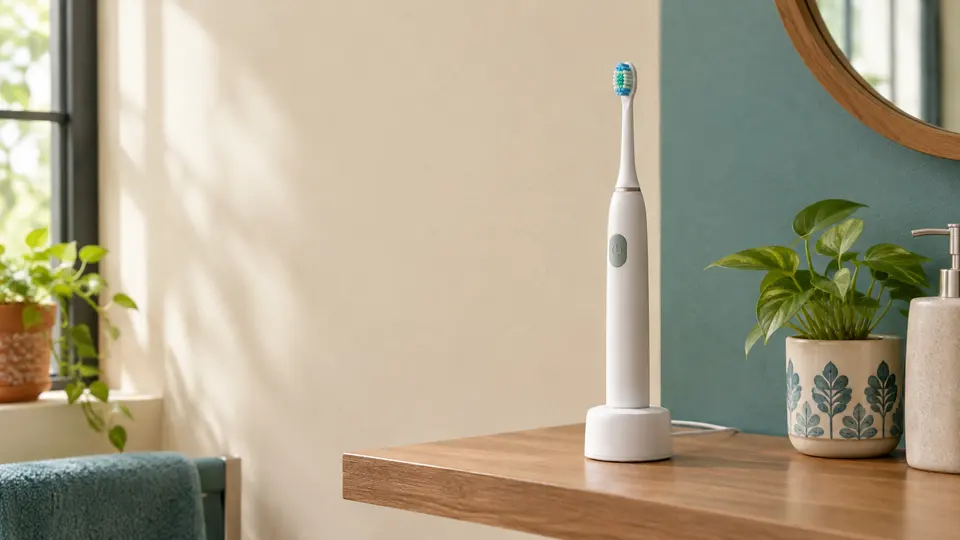
Sonicare ProtectiveClean 4300: sensor, timer and battery
Pressure feedback sets the 4300 apart: Philips lists a pressure sensor, along with QuadPacer and SmarTimer, and one Clean mode that has Low and High intensity. No other model here lists any of that.
Charging is the other draw, and Philips states a rechargeable lithium ion battery with operating time of up to 2 weeks, which is a ceiling set by the brand.
The brush comes with one W2 Optimal White head and a limited warranty of 2 years. Philips does not mention a travel case.
Philips also claims that the brush removes 7x more plaque than a manual brush, with no visible footnote for the comparison. It is repeated here only as a statement by the brand.
One by Sonicare HY1100: battery brush with a buzz timer
Charging cables are absent from the Philips One by Sonicare, a battery brush with the motor in the handle and soft bristles. Its smart timer buzzes every 30 seconds and again at the end of the session.
In a two minute session that makes four buzzes, three at 30 second intervals and one at the end.
Three colours are offered, Miami, Midnight Blue and Manhattan, with a warranty of two years. Philips does not state the battery type, the run time or which brush head is included, and it lists no modes.
It suits a first time electric user who wants a timer led brush without a charging cable. The buzz during brushing is the feature that separates it from the two Colgate models.
Colgate 250R and the shared refill heads
Refill heads are the strength of the 250R. Colgate says the ProClinical refill heads fit the 150B, the 250R and the 500R, so one head type serves a small range, and they come in several variants.
Colgate lists the brush with one head and a charger, and states a charge lasting 8 to 10 days depending on use. A two minute timer is described in the Colgate FAQ.
A launch release adds sonic action of up to 30,000 strokes per minute and an LED charge indicator. That release said Colgate India was launching the ProClinical 150, 250R and 500R ranges.
The Colgate India site links to no individual product page for the 250R and gives no warranty period. Details come from the category listing, the FAQ and the release.
Colgate B150 and its AAA cells
Little is written down for the ProClinical B150. Colgate describes it as battery operated, using AAA alkaline cells, and gives it a two minute timer in the FAQ.
No battery life figure, no brush head count and no modes appear for this model, and Colgate states no warranty. Its refill heads are shared with the rest of the range, since the FAQ names the 150B among the fits.
A battery brush removes the charging step, though neither battery model has a run time in writing. Colgate lists the same two minute timer for the 250R, so the B150 matches its rechargeable sibling on that point.
Colgate states no warranty for either of its two models, and it lists a two minute timer for both.
NHS and ADA advice on powered brushes
Dental bodies do not treat an electric brush as a requirement. The NHS says it does not matter whether a person uses an electric or a manual toothbrush, as long as every surface of every tooth is cleaned with fluoride toothpaste.
Both bodies give the same brushing schedule, twice a day for about two minutes, and the NHS adds that the last brush of the day should come just before bed.
The American Dental Association (ADA) says either a manual or a powered brush can be used effectively. It adds that powered brushes can cost more, and that they may be easier for people with dexterity problems or braces.
For adults the NHS advises toothpaste with at least 1,350 parts per million of fluoride. The excess is spat out, and rinsing with water afterwards is not advised.
On bristles and pressure, the ADA recommends a soft bristled brush used with gentle pressure. That is the nearest dental guidance to a pressure sensor, and a dentist is the person to ask about gum or tooth problems.
The ADA Seal and brand claims
Products are evaluated for the Seal by the ADA Council on Scientific Affairs, and powered brushes are tested against standards and also a clinical study before it is given. None of the India brand material mentions the Seal, so the four models cannot be sorted by it.
Phrases that begin with up to, whether for battery life or for brush speed, are ceilings set by the manufacturer. A reader is left to treat each one as a brand statement.
With dental sources treating both kinds of brush as acceptable, the choice between models rests on practical points. Those are the battery system, the timer, any pressure feedback and the supply of replacement heads.
Rechargeable or battery powered
A household with a charging point at the basin can look at the rechargeable pair, and one that prefers to swap cells can look at the battery pair.
The rechargeable figures are upper limits. Colgate’s depends on use, and neither battery model states how long a set of cells lasts.
Both brands build a timer into the models compared here. Pressure feedback appears on the 4300 alone, and neither Colgate model mentions it.
Philips splits its two models between a rechargeable 4300 and a battery One, and Colgate splits its two the same way between the 250R and the B150.
The rechargeable pair
Philips carries more written detail on features for the 4300, from the pressure sensor to the timer and the mode. Colgate states a charge duration in days for the 250R and a wider choice of refill heads.
Only Philips states a warranty for its rechargeable brush. Colgate gives none for the 250R, and its India site links to no individual page for it.
Both rechargeable models come with a single head, a W2 Optimal White on the 4300 and one head with a charger on the 250R.
The battery pair
Within this pair, the Philips One names its warranty and its colours, while the Colgate B150 names its battery type. Each leaves out something the other states.
Both models take cells and not a charger, which keeps the routine simple. Neither states a run time, so how long a set of cells lasts is not something either brand has put in writing.
Timers across the four models
Every model compared here carries a timer of some kind, so timers separate the four less than they first appear to. The NHS and the ADA both give brushing time in minutes, and each model covers that need.
What differs is the description: the Philips One buzzes during the session, the Colgate pair is described only as having a timer, and the 4300 names three separate timing and pacing features.
Colgate’s FAQ gives two minutes for the timer on both of its models, the same length the NHS and the ADA give for a brushing session.
Heads, travel cases and warranty terms
A brush head is the part of an electric toothbrush that touches the teeth, and replacement heads are the running part of owning any of these brushes. Colgate says its electric heads should be replaced on a regular schedule, and Philips lists the W2 Optimal White head with the 4300.
ADA guidance is to replace a toothbrush or head every three to four months, or sooner when the bristles are matted or frayed, and Colgate gives about every 3 months for its electric heads.
The Philips One material does not say which head is in the box. How many heads are supplied and how many replacements are sold is worth asking about before ordering.
Travel is one practical test. The 4300 material does not mention a travel case, the Philips One lists no accessories, and the 250R is listed with a charger. The Colgate 500R, which is outside this comparison, is the one listed with a travel case.
Warranty separates the brands clearly. The two Philips models state one, while Colgate states none for either of its two.
Shower use and water ratings
Colgate states that all of its electric toothbrushes are waterproof and can be used in the shower. The Philips pages for the 4300 and the One give no water rating.
Other Sonicare and ProClinical models
Philips India lists its Sonicare ranges as Philips One by Sonicare, ProtectiveClean, 3000 Series and 1000 Series. The 3100 series model HX3671/13 carries a Discontinued label on the Philips India site.
Colgate also lists a ProClinical 500R on its India site, described as rechargeable with one brush head, a travel case and a charger.