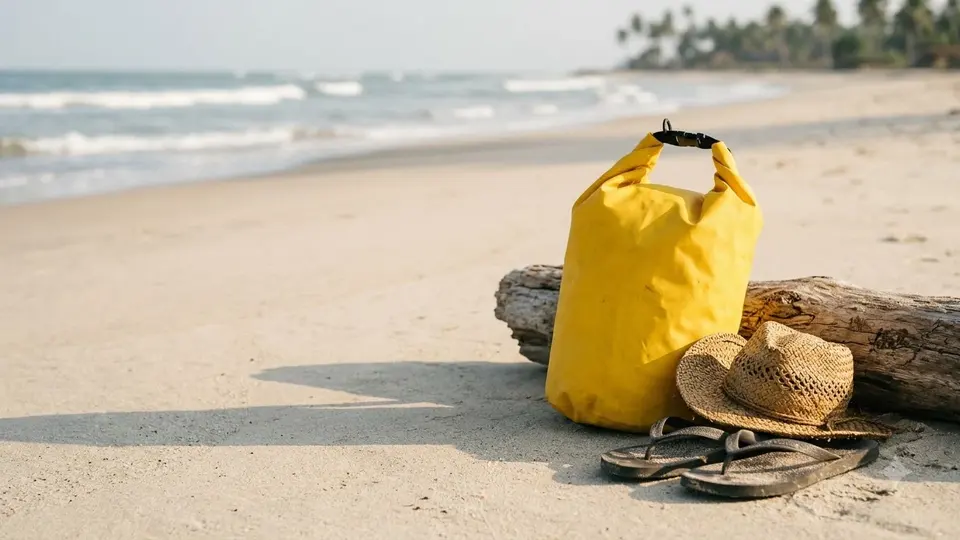
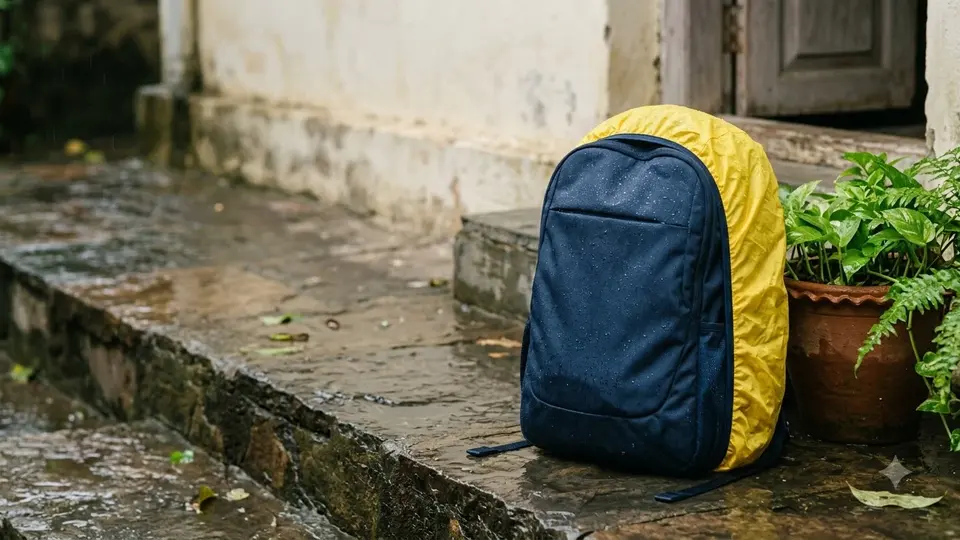
Buyers looking for the best dry bag for beach and river trips should read one detail first on each listing, which is whether the seller says the bag floats. Only one of the six makes that statement, so the rest have to be compared on size, closure and fabric. The six bags are the OverBoard 20 L Dry Tube, the Sea to Summit Big River, the Decathlon IPX6, the Lowe Alpine DrySac, The Clownfish PVC bag and the Adventure Pro, and every detail is what a brand or a seller prints.
Floating statement on a tube
A bag that keeps water out is not the same as a bag that stays on the surface. The retailer quotes OverBoard as saying the bag “floats safely if dropped in water”, and none of the other five bags says anything of the kind.
The tube is 600D PVC tarpaulin, listed at 310 g, with a fold seal closed by plastic fasteners. The size is given as 44 x 25 cm, so it is a long cylinder and not a box, and a 1 year warranty is stated.
Tanotis lists it as a “100% waterproof Class 3 bag”. Class 3 is wording used by the brand itself, and no IP or other numeric rating sits beside it.
On a river or a boat, whether a bag floats is the first point a group will want settled. At a beach, where the bag sits on a towel or inside a larger tote, it matters far less.
TPU laminated nylon and a roll top
The Big River is the light option for a day trip on the sand or a short paddle. Its 420D nylon is laminated with TPU film, and the bag weighs 250 g, the lowest stated weight among the 20 L bags.
A roll top closes it, and the seams are double stitched and sealed with tape. The size is 26.4 x 24.4 x 48.1 cm.
The shape is tall and narrow, longer than it is wide. No numeric waterproof rating, floating statement or warranty term is given. The details come from a retailer, Outdoor Travel Gear.
Quick fastening at two points
Decathlon sells this 20 L bag on its own India store, which makes it the only one here described by the maker. It closes with quick fastening at two points, a different arrangement from a roll top.
IPX6 sits in the product name, and Decathlon describes resistance to strong water sprays and waves. That is the nearest any of the six comes to naming beach or boat conditions.
A warranty is stated, though its term is not copied here. Dimensions, weight and material are missing, and the text does not say whether the bag floats or can be submerged.
The small and the large
Lowe Alpine’s DrySac holds 10 L, enough for a phone, a wallet and a towel. At 67 g it is the lightest bag of the six, in 210D nylon with an internal PU coating and a DWR finish.
A roll top with side release buckles closes it, and the seams are fully taped. A thin fabric of this kind is aimed at a short paddle or a day on the sand. The waterproof claim sits in a specifications table with no numeric rating, floating is not mentioned, and dimensions and warranty are missing; the seller is Trekkit.
The Clownfish is the largest at 25 L, in PVC with a roll top fastened by a buckle. A zippered waterproof inner bag, a front zip pocket and a splash proof outer zip come with it.
Width, height and depth are given as 37, 15 and 59, with no units. Weight is 0.6 kg in the description and 0.72 in the specifications with no unit, and since the two disagree, this guide does not pick one.
Floating and warranty are not stated. The retailer, Globalbees, names Merhaki Foods and Nutrition as the marketer, and a food company is an unusual name for a dry bag, so the seller is worth confirming before an order.
Splash use only
The Adventure Pro text calls the bag “not sumbersible”, with the spelling error as printed. It is meant for splashes and not for being held under water.
A 500D material with a matte finish makes up the bag, which has a roll down top closed with a clip and a printed IPX6 rating. Dimensions, weight, floating and warranty are not given, and the brand name is taken from the product title.
It is the one bag whose own text rules out the use a river trip calls for; the retailer is Wanderlooms. Beside the Decathlon it is the only other bag with an IPX6 rating, so those two can be compared on that point alone, and the Decathlon gives more of the surrounding facts.
Spray ratings and immersion
Two of the bags carry an IPX6 label, the Adventure Pro and the Decathlon. Adventure Pro states it as the waterproofing standard, while Decathlon puts it in the product name.
Wikipedia’s IP code article, an encyclopaedia entry and not a standards body, defines the level around jets of water aimed at an enclosure from every direction, which must do it no harm. Its test set up pairs a flow of 100 litres per minute at 100 kPa with a distance of 3 metres.
Immersion appears only at levels 7 and 8 in that article. An IPX6 label therefore does not cover submersion, and this fits with the Adventure Pro text calling its own bag not submersible.
For a beach day that leaves little gap, since spray and waves are what the label is about. A bag that may be dropped from a boat or a paddle board is a different case, and the label says nothing about it.
Both labels are brand claims. Decathlon does not define IPX6, and Adventure Pro gives the standard without test detail. Sea to Summit, OverBoard and Lowe Alpine print no numeric rating at all.
Closures and fabric
Closure style says a lot about how a dry bag is meant to be used, and the six bags use four different arrangements.
Sea to Summit and Lowe Alpine both use a roll top, and The Clownfish adds a buckle to its roll top. OverBoard uses a fold seal on a tube shaped bag, Adventure Pro a roll down top with a clip, and Decathlon quick fastening at two points.
None of the sellers gives a number of turns for the top, or a depth to which the bag can be dipped. Only the seller or the maker’s own instructions can supply that detail.
Fabric splits the bags into two groups. Lowe Alpine at 210D and Sea to Summit at 420D use thin nylon, while OverBoard and The Clownfish use heavier PVC. Adventure Pro lists a 500D material without naming it, and Decathlon names none.
Weight follows the fabric. The lightest stated weight belongs to the thin nylon DrySac, and the heaviest figures belong to the PVC bags.
Stated weights are 67 g for the Lowe Alpine, 310 g for the OverBoard and 0.6 kg for The Clownfish, which gives a second figure of 0.72 with no unit, while Decathlon and Adventure Pro state none.
Beach days and river days
At a beach, the likely contents are a phone, a wallet, a towel and spare clothes, and the main risk is spray, sand and a damp towel. Any of the roll top bags can hold those items, and a roll top keeps a damp towel apart from a phone.
On a river outing, the OverBoard is the only bag with a floating statement. A group that expects the bag to fall into the water has just one text to rely on, and it sits on a retailer site and not on the brand’s own.
Boat days sit between the two, and a group planning one may want a floating statement as well as a spray rating. The Decathlon description of strong sprays and waves is the nearest wording, and The Clownfish lists a splash proof outer zip without any wording on boats.
Four of the bags hold 20 L, which is enough for a towel, a change of clothes and a few small items for one person. The 10 L Lowe Alpine holds less, and a towel may take most of it. The Clownfish at 25 L is the only bag with extra room, and none of the six reaches 30 L.
Warranty terms and ratings
Only the OverBoard prints a warranty length, which is 1 year, and Decathlon states that a warranty applies without giving a term. Sea to Summit, Lowe Alpine, The Clownfish and Adventure Pro give no warranty term at all.
Numeric waterproof ratings appear for two bags, and both are IPX6. Tanotis lists the OverBoard as a Class 3 bag, which is wording used by the brand itself and not a numeric rating.
Where the specifications come from
Most of the details come from retailers and not from the brands. Decathlon is the only maker among the sellers named, and the other five bags are described by Tanotis, Outdoor Travel Gear, Trekkit, Globalbees and Wanderlooms.