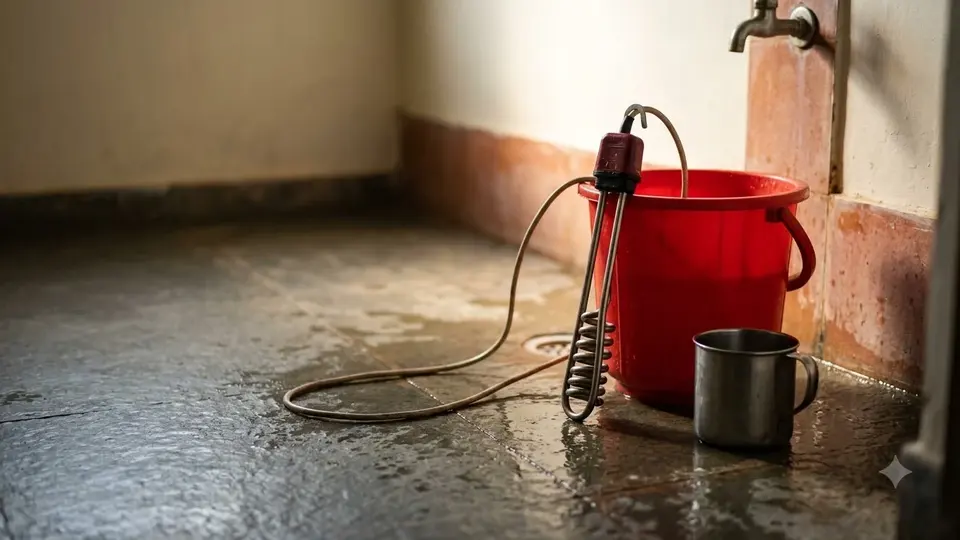
An immersion water heater for bucket use suits a household without a geyser that needs one bucket of hot water at a time, in a rented room or a second bathroom. On a listing, the ISI marking is the line that tells the most, since the four rods do not all state it. Wattage comes second, because all four are rated at 1500 W and that figure only sets how quickly the water heats.
Havells HB 15 with the ISI mark
The maker’s own specification table states an ISI mark under the BIS rating of the HB 15, along with a two year warranty.
Thermal cut off is listed as No in that table. Havells also gives no cord length, no body material, no bucket capacity and no dry run protection.
The rod is aimed at a household that wants certification and warranty terms from the brand itself.
Bajaj Water Proof rod and its sealed terminal
The rod has a sealed terminal and a shock resistant handle, which Bajaj describes as engineering thermoplastic.
It carries a stated ISI marking and a two year replacement warranty. Bajaj gives no auto cut off, cord length, dry run protection or heating element material.
Most of the usage advice in the safety sections below comes from Bajaj’s own articles, so its rod has the clearest written guidance of the four.
Usha IH 2415 from a retailer listing
A thermostat is listed for this rod, the only one among the four to have it. The heater is steel and copper with a concealed plastic top body, and the warranty runs two years for manufacturing defects.
The details come from a retailer listing on StoreKing, not a Usha page. It gives no ISI or BIS marking, dry run protection or cord length, and it lists damage as not covered by the warranty.
Crompton AIMR SPAS15A and range wide details
The rod is listed with a shock proof plastic handle and an anti scale coating, and auto cut off is not mentioned.
ISI certification and the two year warranty come from the Crompton immersion rods collection, where the wording applies to the whole range and not to this rod alone.
That collection gives IP65 in its FAQ and IP68 in another place, so the rating printed on the pack is the one to read.
Reading the specification of a bucket rod
All four rods are rated at 1500 W, so the differences sit in other lines of the specification. Havells and Bajaj state an ISI marking, and Usha does not.
Warranty wording is two years for Havells, Bajaj and Crompton, and two years for manufacturing defects on the Usha. The level mark on the neck of a rod is the other line to look for on the pack.
Rated power and the bucket
A rating in watts tells how fast a rod heats, not how much water it can serve. A 1500 W rod draws more current than a 1000 W one and warms the same bucket sooner.
Bajaj gives a practical rule for filling. Its advice is to fill the bucket about three quarters full of cold water before lowering the rod, and to keep the water above the level mark on the neck of the rod so that the element stays covered.
That mark matters more than any litre figure. A rod placed in a bucket too shallow for its length will leave part of the element exposed, and the level mark is the manufacturer’s own line for this.
Bajaj also says an unearthed extension board may not be rated for a heavy load of this kind.
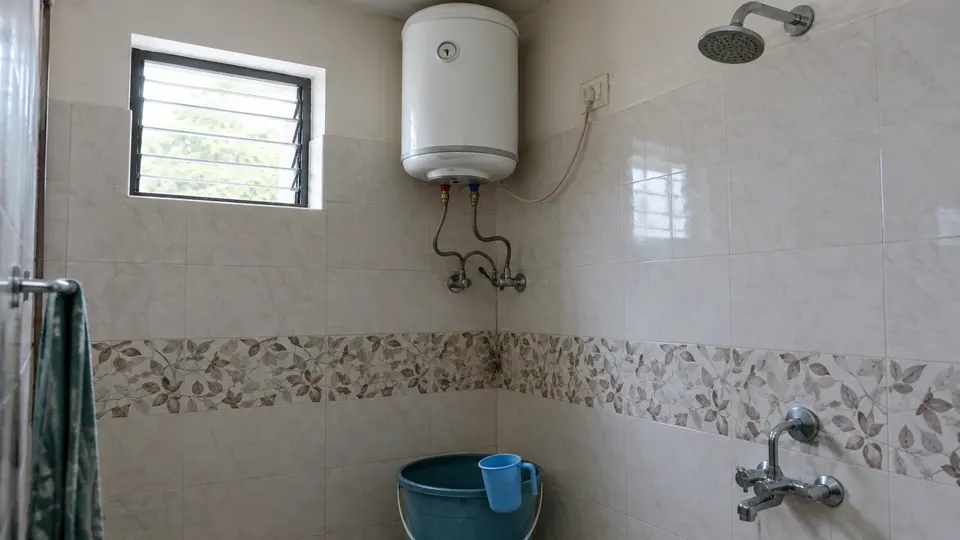
A rod suits one bucket of around 15 to 25 litres for one or two people. A stored water unit for a bathroom is a different purchase.
Thermostats and dry running
Most rods have no thermostat. Bajaj states this plainly, adds that such a rod keeps heating until it is unplugged, and advises against leaving one unattended.
On these four the cut off entry reads differently: Havells lists it as No, Usha lists a thermostat as Yes, and Bajaj and Crompton do not mention an automatic cut off.
Dry run protection is confirmed for none of the four rods, so a rod switched on in air should be treated as unprotected.
BIS standard IS 368 covers portable immersion water heaters without a thermostat that have a flexible cord and connector. Provision for earthing is among its requirements, along with protection against access to live parts and with leakage current and electric strength. The excerpt available shows section headings only, so it gives no numeric limits.
The ISI mark and what it covers
Bajaj calls the ISI mark the clearest quality signal at the point of purchase. Its safety article adds that certification applies to the product as manufactured, and that it does not guarantee the condition of a rod later.
A cracked handle or a frayed cord on an older rod is therefore a reason to stop using it, whatever mark is printed on the body. GeoHazards Society, a not for profit body, asks for proper earthing and an ISI marked or internationally made unit, although its page is about water geysers and not about rods.
On the pack, the ISI mark, the level mark on the neck and the warranty wording are the lines that carry these details, along with any thermostat or cut off entry.
Using the rod: socket, water and switching off
Bajaj and Orient Electric give steps that match closely. Orient Electric recommends an earthed socket, ideally protected by an ELCB or RCCB, and Bajaj asks for a three pin socket in place of a two pin adapter.
- Fill the bucket about three quarters full and lower the rod until the level mark is covered.
- Plug in only after the rod is in the water, and stay in the room while it heats.
- Turn the socket off, unplug, and then lift the rod out.
- Leave the rod submerged for at least 15 seconds after switching off, as Orient Electric recommends.
Bucket material and the heating area
Bajaj and Orient Electric do not agree on buckets. Bajaj advises plastic or fibre, and says a metal bucket can become live if the insulation fails. Orient Electric mentions metal or heat resistant buckets in one place and non metallic ones in another.
Each rod ships with a manual that carries the maker’s own instructions, and a plastic bucket rated for hot water matches the Bajaj guidance.
Orient Electric asks that the heating area be kept clear of children and pets for as long as a rod is in the bucket.