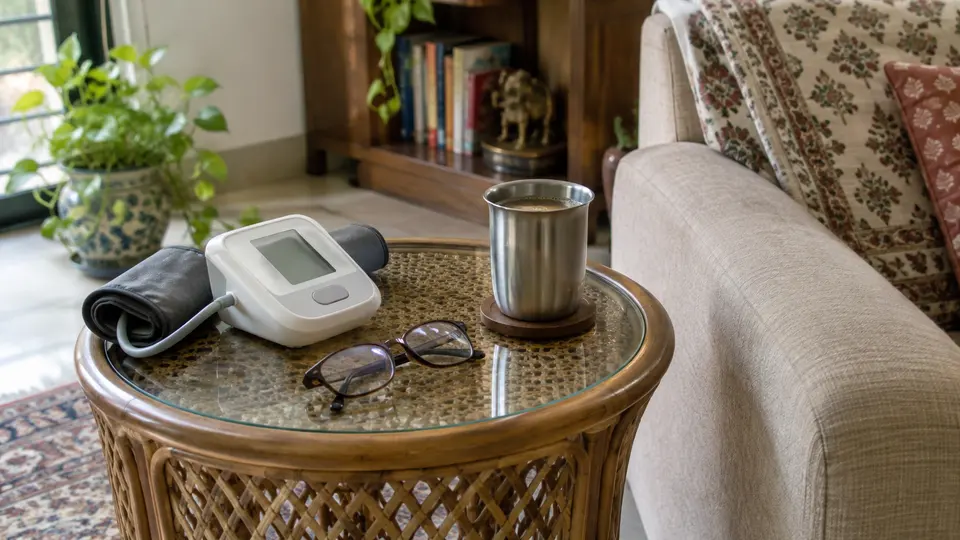
The choice is between a home blood pressure monitor and a vision aid, and the parent’s habits settle it. Among gift ideas for elderly parents, a monitor suits one who would like to follow blood pressure from home, while help with eyesight suits one who holds reading material farther away than before or mentions tired eyes and headaches after reading.
This is general information and not medical advice. None of the six monitor descriptions supplies an accuracy claim.
Omron HEM-8712: cuff range and box
Its cuff is stated for arms of 22 to 32 cm, and an optional AC adapter is listed. No other model here states a cuff range, a box and a power choice together.
The box holds the main unit, the cuff, four AA batteries and an instruction manual, so it can be used as soon as it is unwrapped. That matters for a gift handed over in person, with no second trip for batteries.
Stored readings are not mentioned for it. A larger arm takes the model out of the running, and a parent whose arm falls inside the range gets a basic reading.
Omron sells it with a warranty shown as three years on the pack, although the retailer lists no further terms.
Matching the cuff to the arm
Cuff fit comes first for any monitor. The American Medical Association (AMA) cuff guide asks the user to measure the middle of the upper arm in centimetres and then pick the cuff range that covers the number.
The guide lists adult cuffs for an arm circumference of 27 to 34 cm. Small adult cuffs are listed for 22 to 26 cm.
It is adapted from an American Heart Association statement, and it does not say what happens when a cuff is too small or too large. Arkray calls its TrustCheck cuff universal and lists 22 to 40 cm, a span that covers both AMA ranges.
Two other models give no range at all, and the compare table marks those cells as not stated. The cuff details printed on the pack are the only source for those.
Memory for two users: Arkray and Intellitrack 131
Arkray gives the TrustCheck BPM 2.0 the largest memory of the six, 99 tests for each of 2 users. That suits a couple who would otherwise share one list of readings.
It runs on AAA batteries, and 4 are listed as included.
The package list does not confirm that the monitor and cuff are in the box, and a USB port is mentioned without saying how it relates to power.
Dr Trust makes the Intellitrack 131 with a memory function for 2 users as well. It runs on 4 AAA batteries or through a Type C micro USB connection.
One monitor and one cuff come in the box. The cuff is described only as universal size, and the number of stored readings is not given.
Dr Trust says an extended warranty needs registration within 15 days and covers manufacturing defects only.
Stored readings, downloads and a talking display
Omron lists the HEM-4030 with a memory of 14 sets of readings, for a parent who wants a stored list and is content with one standard cuff.
That cuff is a medium size measuring 146 x 446 mm, and the box contains the main unit, the cuff, an instruction manual and a battery set. No arm circumference range appears for it, and the power type is not given either.
The HEM-7600T Smart Elite+ has a 360 degree IntelliWrap cuff and lists memory download as yes. Multiple user memories are listed as no, so it keeps no separate records for two people. Cuff size range, power source and box contents are not stated.
Dr Trust sells the A One Max Connect as an automatic talking monitor, according to its product title. Multiple user memories and memory download are both listed as yes, and an app stores the test data.
A parent who would rather hear a result than read a small display is the one it addresses, and a family member can keep a phone record. Cuff size, reading capacity, power source and box contents are missing.
Kinds of memory
A stored list of readings gives a parent something to show a doctor, and five of the six monitors mention some form of memory. The HEM-8712 is the one that states none.
The kinds differ. Arkray and the Intellitrack 131 keep records for two users, the HEM-4030 holds a single list, the HEM-7600T lets the readings be downloaded, and the A One Max Connect keeps them in an app.
Power, warranty and box contents
Upkeep depends mostly on how the monitor is powered. The HEM-8712 and the Intellitrack 131 each state a battery option and a second route, an AC adapter for one and a micro USB connection for the other, while Arkray lists AAA batteries only.
Warranty terms appear in most of the descriptions, but the lengths come from retailer copy and not from a warranty document. All six specifications come from retailer listings and not from brand sites, so the pack in hand may differ.
Omron lists batteries with the HEM-8712 and Arkray lists them with its model, whereas the HEM-7600T description says nothing about what is inside. Arkray and the A One Max Connect both list a warranty without giving its length.
Vision aids
A parent who reads less than before may have presbyopia, which NEI, the National Eye Institute, describes as a normal part of ageing. People with it may hold reading material farther away, and they may notice eye strain or headaches.
Brighter reading lights and large print material are the first steps NEI lists, with over the counter reading glasses as one option. An eye doctor can confirm presbyopia in a full eye exam and prescribe lenses.
Low vision is a different matter. As per NEI, glasses, contact lenses, standard medicine and surgery cannot fix it, and it is usually permanent. Ageing alone does not cause it, although the eye diseases behind it are more common in older adults.
For low vision, NEI lists a magnifying lens for reading and other close tasks, along with brighter light and anti glare sunglasses. Phone and computer settings can raise contrast and enlarge text.