OSHA, the United States workplace safety regulator, says chair height is appropriate when the entire sole of the foot can rest on the floor. A footrest is the fix only where the seat cannot be lowered that far, and a lumbar cushion answers a different problem at the lower back.
The best footrest for office chair use is therefore decided by the desk and the seat first. Of the five products below, two are tilting footrests and three are lumbar cushions.
Feet, seat height and the desk
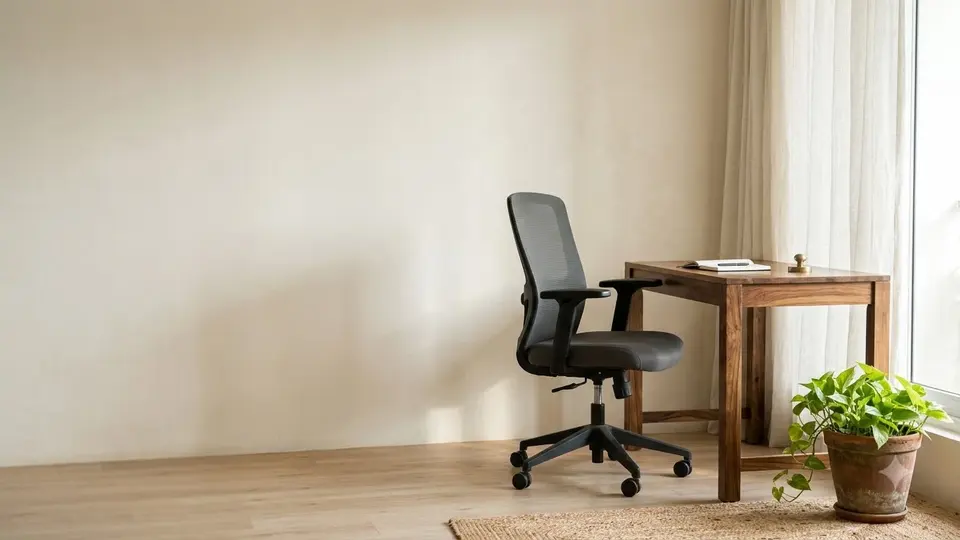
Many people work from home at a desk of fixed height on a basic office chair, and the first question is whether the feet reach the floor.
Half a minute is enough for the test. Sitting back in the chair, a person can see whether both soles lie flat and whether the seat supports most of the thigh, which is the other point OSHA makes about the seat pan.
If the seat can be lowered until the soles rest flat, OSHA does not point to a footrest as the first step. It words the aim as feet resting flat on the floor or on a footrest, so a footrest is a substitute surface and not an extra.
The usual case for one is a fixed height desk, where lowering the chair would drop the arms and keyboard below a comfortable level. OSHA says a footrest can then give the feet stable support.
Measuring the gap is simple: with the back against the chair, the distance from the floor to the soles shows how much support a footrest would have to supply.
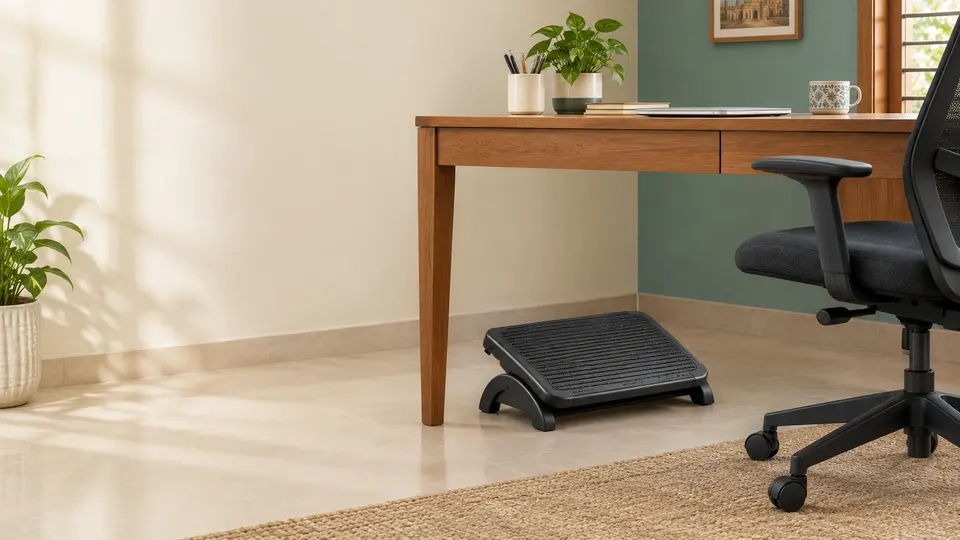
A footrest answers dangling or poorly supported feet and nothing else. Both footrests here are tilting models, which let the ankle move through a small range, unlike a flat block that holds one angle.
OSHA on the lumbar curve
The backrest should follow the natural curve of the spine and give adequate lumbar support, as per OSHA. It adds that a height adjustable lumbar support is worth looking for, and many basic chairs lack one.
For such a chair OSHA mentions a rolled up towel on a temporary basis. A strap on lumbar cushion is the manufactured version of the same idea.
Cushion and footrest cover different problems. A person with both problems may need both items, and a person whose feet already rest flat has no use for the footrest.
Kensington Space Saving: settings and size
The Space Saving Foot Rest is a slim tilting model with settings of 12 or 18 degrees, a non slip base and a washable surface, and no height adjustment is listed, so the two angle settings are the only adjustment stated.
Its size is given as 16.5 x 8.9 x 2.8 to 3.1 inches, although the axes are not labelled. Kensington states a limited warranty of 2 years, and the slim profile suits a desk with little clearance below it.
One gap matters. The source is Kensington’s global site and not an India one, and nothing there shows whether the item can be ordered from India. Local availability would need confirming before any plan rests on it. Among the two footrests, it is also the only one that states a warranty period.
SuperErgo Core Balance and a short description
The Core Balance Tiltable Footrest is sold by SuperErgo for a desk worker whose feet do not reach the floor and who wants a tilting surface instead of a fixed block. That is nearly all the maker says about it.
No dimensions, material, tilt range or load rating are published, and the warranty policy sits on a separate page. Fit cannot be checked from the product information alone.
SuperErgo publishes no platform size, tilt angles, base or load rating, and it says nothing on cleaning either. The tilting surface may still suit the desk worker the maker describes.
Green Soul ErgoCore: straps and cover
The ErgoCore is a memory foam cushion with adjustable elastic straps, an anti skid bottom and a removable washable mesh cover. It weighs 800 g and measures 6.86 x 43.18 x 40.64 cm.
Green Soul says the straps secure it to an office chair, a car seat or a wheelchair. That suits someone who wants one cushion for both the desk and the car.
Claims such as relief from back pain or better circulation appear in the brand’s own material, with no independent evidence cited for them. No warranty terms are given, as they sit behind a link to a separate policy.
Sleepycat and Wakefit cushions
The Sleepycat Lumbar Seat Cushion is a firm, contouring memory foam piece of 15.5 x 8 x 5 inches, sold in a single size. The cover is a removable, machine washable dual layer of nylon, and a 7 day return window is stated.
Sleepycat does not say how the cushion attaches to the chair. Its warranty is stated inconsistently between a badge and the specifications, so neither figure can be relied on.
Wakefit lists a Back Support Cushion with a hollow fibre fill, and the brand says air flows between the layers. A strap fastens it to the seat, and it is meant for office chairs and car seats.
Variants are offered, but their dimensions and warranty are not stated. This is the lighter, fibre filled cushion from a furniture brand.
Matching the problem to the product
Dangling feet at a fixed height desk are the case for a footrest, and the Kensington is the one footrest that states its tilt settings and a warranty period. A gap at the lower back is the case for a cushion, and the Green Soul ErgoCore states the most detail of the three.
Someone with both problems may need both items. Stated size, strap fit, a washable cover and the return window are the points the listings allow a buyer to compare.
Warranty, returns and washing
Terms are spread unevenly across the five products. Kensington states a limited warranty, though on a global site, and SuperErgo and Green Soul send readers to separate policy pages. Wakefit states no warranty at all.
Sleepycat gives conflicting warranty figures, one on a badge and another in its specifications.
Strap fit and cover removal are the cushion details that decide daily use. Green Soul and Wakefit describe straps, and Sleepycat does not.
Return terms matter more for a cushion, since firmness and size are hard to judge from a description. A footrest has fewer such variables, but the missing dimensions on the SuperErgo make a return window relevant there too.
Three of the five describe something washable: the Kensington surface, the Green Soul mesh cover and the Sleepycat nylon cover. Wakefit and SuperErgo say nothing on cleaning.